New Site Redirect

Thursday, May 13, 2010

Toyota Museum

Toyota's Commemorative Museum of Industry and Technology (we call it Toyota Technology Museum for short) in Nagoya is a mind-boggling museum with massive information about Toyota.  Everything from the history of Toyota to today's modern technology is showcased. Our Japan Lean Tour group spent an afternoon learning about Toyota Way in this historic site!


Take a look at their virtual tour:

Toyota Technology Museum Tour

Nissan Oppama Plant


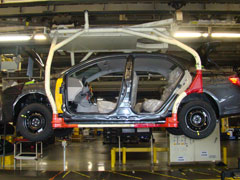
Yesterday, we viewed Nissan's engine plant.  And today, we complete the "package" by visiting the Oppama car plant in Yokohama.  Designed to produce cars every minute (it takes 16 hrs to create the entire car), the Oppama plant is a highly efficient plant that utilizes flow production principles. Our LSI team learned a great deal!

Sashimi!

Our Japan Lean Program cannot be complete without some great Japanese meals.
Fresh from the nearby Tsukiji fish market, the Sashimi brings subtle flavors.

Wednesday, May 12, 2010

LSI Team visits Nissan Engine Plant


Today, LSI Japan program participants visited the world-renowned Nissan Engine Plant in Yokohama.  In addition to producing award winning engines for a variety of cars, this plant also hand-produces the incredible engine for the Nissan GT-R high performance sports car.  Built inside a "clean room," the engine for GT-R is built by one operator from the beginning to the end, resulting in a precision product.  Take a look at this factory brochure to get full information about the plant:

Nissan Engine Factory Brochure

Tuesday, May 11, 2010

Toyota Records Surprising Profit

Toyota Posts $2.2 Billion Annual Profit


Source: New York Times

TOKYO — Toyota roared back to a profit in the fiscal year that just ended and forecast a further jump in earnings on Tuesday, shaking off the effects of a crippling global slowdown and a safety scandal that has threatened to ruin the Japanese automaker’s cherished reputation for quality.

Toyota thwarted a third consecutive year in the red thanks partly to a strong performance in the three months through March — the period when the Japanese automaker recalled millions of cars and was under the intense scrutiny of consumers and governments around the world .

Net profit for the three months was ¥112 billion, or $1.2 billion, compared with a ¥766 billion loss the year before, as the automaker slashed costs and introduced aggressive sales incentives that lured customers back to its showrooms.

“After taking over amid a storm, I wanted to do anything to avoid a third straight year in the red,” Toyota’s president Akio Toyoda, who took helm at the company in June 2009, said after the earnings announcement. “These results follow tough and anguishing decisions” on the part of Toyota’s management, he said, referring to the automaker’s dismissal of workers both in Japan and overseas amid company-wide cost cuts.

Quarterly revenue jumped to ¥5.28 trillion from ¥3.54 trillion the previous year, when car sales slumped in the midst of the global financial crisis. Revenues showed an especially strong rebound in the dynamic Chinese market and in the United States, while sales in Europe and Japan continued to slump.
Toyota estimated net income to rise to ¥310 billion in the business year through the end of March 2011, a conservative estimate. It expects to sell 7.29 million units, or 53,000 more than it sold this year, the automaker said. Toyota also announced a cash dividend for the full fiscal year of ¥45 per share.

For the past business year that just ended, net income rebounded to ¥209.4 billion, or $2.2 billion, from a loss of ¥437 billion the previous year.

Live Sumo

Right after visiting Toyota Logistics, our LSI Japan Lean team had a bit of free time to visit and watch the world-famous Sumo live!  We were speechless.

Big thanks to Doddy from Alpha for taking some photos for us!

LSI visits Toyota Logistics and Forklift in Japan

Perhaps the best material management and logistics company in the world, Toyota L&F (logistics and forklift) provides full turn key service for designing, implementing and managing a variety of material handling system.  LSI visited this world-class traininng center and spent several hours with our Japan Lean Tour group to learn the latest technique about advanced kaizen, 5S, inventory management and supply chain.


Monday, May 10, 2010

Poka Yoke Parking Lot

Why bother giving "tickets" for expired parking meters if you can just prevent the driver from taking off in the first place until the money is paid?  Tokyo's "poka yoke" (error proofing) parking system prevents unpaid parking problem by simply "locking" the car with a computerized plate mechanism that is raised when the car is parked.  The only way the driver can actually leave the parking spot is to pay the full amount due, which is tracked by a sensor/timer when the car is first parked.  Completely automated and error proof ... only in Japan!

Tokyo Visit


Some of the members of LSI's Japan Lean Tour program arrived early to enjoy Japan.  Bill and Rich from Moulding and Millwork pose for a shot with LSI's Bob inside Tokyo's famous subway.  They are heading to Ginza after visiting Shinjuku.


Sunday, May 9, 2010

LSI in Japan!

Shibuya

Tsukiji fish market

We are in Japan to begin the Japan Lean Tour.  Japan is a country like no other in the world. It built its economic power through manufacturing over the past several decades, earning a reputation around the world as the “lean specialist.”


Even though many lean best practices can be found throughout North America, the truly “serious” lean practitioners still find that Japan is the only place that can showcase lean implementation in its purest form. This is partly because lean can be seen in everyday life in Japan, not just in production or engineering. People who travel to Japan are fascinated by the fact that even restaurants and gas stations utilize lean in a way North Americans have not imagined. It’s difficult to truly appreciate lean until you have seen and experienced Japan hands-on.

Lean Sensei International is proud to have taken a group of North American lean practitioners to Japan for the past several years. We have taken more than 500 people to Japan.The program is intentionally designed to provide both educational and cultural exposure to Japan through various plant tours and historical sites. Tours have been arranged with such big hitters as Toyota and its suppliers, but also with smaller players that can showcase different levels of lean implementation.

David Chao, who was born and raised in Japan and therefore is fluently bilingual, will accompany the group and provide cultural and lean insights throughout the trip based on his 20-year lean experience Just about everything is taken care of while you are there and two bilingual specialists will accompany the group for the duration of the trip.  On this trip, we also have Joey Higuchi and Bob Low in this group.

Japan Lean Tour is part of Lean Sensei International’s “Lean Executive Program.” and also a standard module in our blackbelt program.

Thursday, May 6, 2010

LSI ready for Japan Trip

Next week is the beginning of LSI's most respected and most admired program of all: Japan Lean tour. Designed to immerse participants into "evryday lean living", people will learn so much about the true meaning of lean that it will be overwhelming. Schedule includes benchmarking trip to Toyota, Dento, Nissan, Olympus, and Toyota Forklift. It will be life changing! Expect a lot of microblogging via my international blackberry I am using....


Saturday, May 1, 2010

Malcolm Gladwell

Did you know that Malcom Gladwell, the author of the books Blink, Tipping Point, and the Outliers, is going to be speaking at this year's AME Lean Conference in Baltimore?  He is a fascinating speaker and writer, though he has an "unusual" haircut!  Take a look at some of his speaking engagements on youtube:


Friday, April 30, 2010

TOYOTA NORTH AMERICAN QUALITY ADVISORY PANEL

LEADING SAFETY AND QUALITY EXPERTS NAMED TO TOYOTA NORTH AMERICAN QUALITY ADVISORY PANEL


Industry, Government, Education and Non-Profit Leaders Join Former U.S. Secretary of Transportation Rodney Slater to Advise on Quality and Safety

Source: Toyota News

NEW YORK, NY April 29, 2010 – Former U.S. Secretary of Transportation Rodney E. Slater announced today the appointment of six highly-regarded safety and quality experts to Toyota's independent North American Quality Advisory Panel, completing the Panel's membership. The distinguished roster of experts, with experience spanning the corporate, government, education and non-profit sectors, join Secretary Slater, who was named in March to lead the new Panel.

Secretary Slater was instrumental in the selection and approval of the newly-appointed Panel members. The full Panel includes:

· Rodney E. Slater, former U.S. Secretary of Transportation;

· Norman Augustine, former chairman and CEO, Lockheed Martin Corporation;

· Patricia Goldman, former Vice-Chairman, National Transportation Safety Board;

· Mary Good, Dean of Engineering and Information Technology, University of Arkansas at Little Rock, and former President, American Association for the Advancement of Science (AAAS);

· Roger Martin, Dean, Rotman School of Management;

· Brian O’Neill, former President, Insurance Institute for Highway Safety; and

· Sheila Widnall, Professor, MIT and former Secretary of the U.S. Air Force.

This independent group of experts will advise Toyota’s North American affiliates on quality and safety issues, working closely with the company’s leadership team and the newly-formed North American Quality Task Force, led by Chief Quality Officer, Steve St. Angelo. Panel members will have unfettered access to information concerning Toyota’s quality and safety procedures and direct communication with Toyota Motor Corporation President Akio Toyoda as well as with the newly-formed Special Committee for Global Quality, led by Mr. Toyoda. The Panel will also be able to commission additional outside reviews and will have the resources necessary to pursue its mandate.

“Toyota is in the midst of a significant global effort to strengthen our quality assurance operations and set a new, higher standard for vehicle safety and reliability. We are committed to taking the steps necessary to exceed customer expectations in every way possible,” said Mr. St. Angelo. “Engaging the experience and counsel of independent experts is a critical component of this process. We are honoured to have each of these accomplished leaders partner with us to help ensure that we achieve our goals.”

“I’m pleased to be working with a group of such distinguished leaders. Each panel member is widely respected for his or her individual background, expertise and capabilities – in business, transportation, government and safety,” said Secretary Slater. “Taken together, this group has the diversity of experience and depth of knowledge needed to offer sound advice, guidance and counsel to Toyota regarding its safety and quality protocols.”
The Panel's immediate priority is to develop an in-depth understanding of Toyota's safety and quality control processes, including the significant steps the company has already taken to further improve its quality assurance capabilities. The Panel has already begun on-site reviews of the company's key operating facilities, plants and technical centres around North America. In May, the Panel will travel to Japan, where they will meet with senior company executives, including President Akio Toyoda, and visit the company's quality, research and development, and technical centres.

As one of its first actions, the Panel will undertake an evaluation of the electronic throttle control system (ETCS-i) installed in Toyota and Lexus vehicles and its findings will be made public. For this evaluation, the group will have full access to the results of extensive testing previously and currently conducted by Toyota as well as the comprehensive, independent study being undertaken for Toyota by Exponent, a leading engineering and scientific consulting firm based in Palo Alto, California. As part of its on-site reviews, the Panel will visit Exponent's facilities and meet with the firm's engineers.

Thursday, April 29, 2010

Our lean programs


Considered by our clients to be the most effective and experiential lean certification programs in the industry, LSI offers two tracks of certifcations: Lean Belt Certification for people who want to become lean champions and specialists ("lean implementors and leaders"), and Executive Lean Certification for those who manage, lead, or strategize lean ("lean sponsors and ambassadors"). Japan Lean Tour is the "ultimate" benchmarking trip, in which you visit and see some of the best plants in the world.

Did you know that we offer more lean certification programs than any other company in Canada? For more info, please see our website:

LSI Certification Programs

Sunday, April 25, 2010

Secret Toyota Site


Well, actually not really a secret site, but this is the corporate website for Toyota headquarters that is not normally publicized.  It is in English but most people are not aware that this site even exists. It provides many insights about the current affairs at Toyota and also contains latest information about Toyota's financial/technical situation.

Take a look.....

Toyota Corporate Site

And if you click the link below, you will see the latest video/audio/PDF presentations by the president Akio Toyoda regarding their latest thoughts on the quality issues.

Toyota Presentation

Wednesday, April 21, 2010

Master Blackbelt

Did you know that LSI has a Master Blackbelt Program?  Available only by invitation and limited to one or two people per year, the MBB candidates have to go through an extensive internship with LSI that are "out of this world", according to one MBB who graduated previously.

The attached video, created by a former MBB, shows some of the activities they go through.  Funny and somewhat informative, it provides insight into what the MBB program is about. This is an oldie, but it's worth watching.

Sunday, April 18, 2010

Tulsa Oklahoma Graduation for Greenbelt!

It's a busy month, with so many people graduating from our Greenbelt Certification Program.  This past week, our US Greenbelt participants in Tulsa, Oklahoma completed their busy program to graduate successfully.  A big thank you to our Bob for facilitating this week and to everyone who contributed to the program!


Thursday, April 15, 2010

Manitoba Greenbelt Graduation

LSI offers Greenbelt in numerous locations, including Calgary, Toronto, Tulsa (Oklahoma), Winnipeg, and of course, here in Vancouver.

But outside Vancouver, the Winnipeg Greenbelt class is the longest running Greenbelt.

Just recently, another amazing class of Greenbelt in Winnipeg, Manitoba, graduated. Congratulations!


Wednesday, April 14, 2010

Our most viewed video on youtube.com

Did you know that this video - from the Japan Lean Tour 2008 - is our most viewed video on youtube? It has more than 9000 views! I am not sure why it gets so much hits, but perhaps it's because we had fun creating it and our passion shows through.

It is a summary of the Japan Lean Tour in 2008, in which our Lean Blackbelts participated in a creative "fear factor" lean show. LSI has taken more than 350 people to Japan through this program so far!

Sunday, April 11, 2010

Lean Trek

The winter class of 2010 Greenbelt has created a special video summarizing their accomplishment, but in the form of Star Trek spoof! This is the best video ever created by a Greenbelt class in the past decade!

Congratulations to the entire class of Winter 2010, which received the Lean Greenbelt Certification!

Thursday, April 8, 2010

More from today's Greenbelt class

Our last presenter at Greenbelt class of winter 2010 delivered a short but effective ice breaker.  We all practiced some kung-fu moves!  Thanks Danny!

Vancouver Greenbelt Live!

Live from Vancouver Greenbelt Winter class of 2010

I am microblogging from our great class of Greenbelt Winter 2010, who are graduating this week. They are doing their presentation today, providing information about what they learned and what they accomplished.  23 people are in this about-to-graduate class of talented lean believers!

First group "broke the ice" by performing a Greenbelt dance!

Wednesday, April 7, 2010

Lean Philosophy


Does your organization incorporate lean philosophy properly?  Let's think about these questions . . .

• Pull/Demand Replenishment (internal) – does the plant or office pull materials using demand-based philosophies such as Kanban? Are the materials and/or information replenished based on real demand?

• Just-in-Time Supply – do the materials or information arrive just when you need them at the right frequency based on takt time?

• Material/Info Flow & Manufacturing/Office Layout – do the raw materials and WIP or office information/materials flow well within the plant or office from process to process without interruptions? Do they flow easily through the process without getting “stuck” constantly at bottlenecks? Do the materials or information “travel” unnecessarily long distances inside the plant or office?

• Kaizen/Continuous Improvement Environment – is there a philosophy of continuous improvement inside the organization? Are the process improvements performed through teams? How many actual teams exist inside the plant or the office?

• Single-Piece/Small Batch Production – does the plant or office produce items or information in small batches or use a single-piece philosophy? Or do they produce materials or information in large batches with time consuming change-overs and setups? An example for the plant would be batching actual work-in-progress materials. An example for the office would be batching emails prior to reading them or clearing them out of the inbox.

Change Management Question


What about change management?  Does lean and change management go hand-in-hand in your company?  Here are some questions to consider:

• Management mindset – is the management (senior decision makers) “well connected” with the rest of the organization? Do they understand the needs and wants of the people working below them? Do they come across as positive thinkers, full of energy?

• Staff attitude – are the rest of staff (general staff who are not executives) members generally optimistic or skeptical about changes taking place within the company? Do they believe in the people working around them and therefore convey a “can do” attitude?

• Shop floor/employee viewpoints – do the shop floor or office employees believe in changes taking place within the company? Do they support with positive attitude or are they skeptical about the future of the company?

• Positive Culture – has the company created a positive environment that is unique to this organization? Is there culture that inspires teamwork and encourages changes that lead to long-lasting positive impact?

• Reward & Recognition Programs – does the company have a formal program designed to reward positive, process-enhancing behaviors and recognize those who makes things happen? Do they provide incentives and rewards that are consistent and fair?

• Roles & Responsibilities – are the roles and responsibilities of each employee clear, consistent, and understandable?

• Agility & Adaptability – would you consider your company to be agile and adaptable to changing environment, regardless of whether the changes are internal or external? Do they respond quickly to these changes in a positive way?

Tuesday, April 6, 2010

World's first and only lean coffee table book!

World's first and only lean coffee table book!  It talks about "Reflections" and how it can transform the lean world.


Vision & Strategy


Do you plan ahead and integrate lean philosophy into your corporate vision?  Why don't you answer some of these questions to see if you are thinking ahead into the future or if you are just reactive to situations?

• Corporate Vision – does your company have a clear vision and mission statement that provides direction for you personally? Do you know what the vision of the company is?

• Lean Strategy – does your company have a clear strategy for lean and how it applies to each one of you?

• Lean Implementation Planning – does the company spend time planning for specific implementations of lean projects and initiatives? Does the actual plan exist?

• Communication of Lean Strategy – do people know what the company is doing about lean? Does the company communicate about its lean initiatives and projects to everyone in the organization?

Thursday, April 1, 2010

NUMMI

NUMMI's historic journey


In 1984, General Motors and Toyota opened NUMMI as a joint venture. Toyota showed GM the secrets of its production system: how it made cars of much higher quality and much lower cost than GM achieved. But today, GM cars still don't have the quality of Japanese imports, GM is bankrupt and on March 31, NUMMI closed, sending thousands of car workers looking for jobs. In this hour-long story, NPR Automotive Correspondent Frank Langfitt tells the story of NUMMI and why GM – and the rest of the American car business – wasn't able to learn from it more quickly.

The closure of NUMMI is close to my heart as I was one of the first people in Canada to work with the original NUMMI team during the start of Canada's first joint venture, CAMI (Suzuki/GM joint venture). We worked closely with NUMMI transplant team to ensure that CAMI, Canada's first attempt to create its first "lean" plant, will be launched flawlessly while implementing all aspects of a lean system.  In fact, I was the very first employee of this milestone joint venture "lean" plant.

This episode contains interviews with the following individuals: David Champion, Jeffrey Liker, John Shook, Bruce Lee and Joel Smith of United Auto Workers / UAW, Rick Madrid, Billy Haggerty, Richard Aguilar, Earl Ferguson, Ernie Schaefer, Mark Hogan, Steve Bera, Larry Spiegel, Dick Fuller, Geoff Weller and James Womack.

Brief History

1963: General Motors opens plant in Fremont.
1978: The GM plant builds 330,558 cars and trucks, its largest annual production.
1979: Employment at the Fremont GM plant peaks at 6,800.
1982: GM closes the factory.

1984: The plant reopens as New United Motor Manufacturing Inc., a joint venture between Toyota and GM. On Dec. 18, a Nova is the first car to roll off the assembly line.
1985: Nummi's 2,470 employees manufacture 64,764 vehicles.
1987: Canada's first joint venture, CAMI (Suzuki/GM), opens its doors
2002: Employment at the NUMMI plant hits 5,739.
2006: Production at the Nummi plant peaks at 428,632 cars and trucks.
2009: GM pulls out of the partnership.
2010: NUMMI Plant closes.  CAMI remains as a strong player in the Canadian auto industry.


Click on the link below to listen to the free podcast about NUMMI.

NUMMI (click "stream episode")

Wednesday, March 31, 2010

Greenbelt Spring 2010 Kick-off

Another busy week with the launch of Greenbelt class spring 2010 Vancouver!


With 22 people involved in this class of Vancouver Greenbelt, the first module promises to be full of action and energy.  People from all across North America (Vancouver, Calgary, San Francisco, etc) arrived this week to be part of the Greenbelt kick-off module 1.  They will continue onto module 2 and module 3 before they graduate from this intense but highly-rewarding program that creates true lean champions.

Sunday, March 28, 2010

Congratulations Natsuko and Desmond!

Congratulations to Natsuko and Desmond!

Our former Toronto intern Natsuko just got married over the weekend!  A few of LSI staff were able to join this wonderful celebration in not-so-warm Toronto (-5 degrees that day).  Natsuko and Desmond looked beautiful and truly happy!  

Thank you David Meier and Mike Hoseus!


Thank you David Meier and Mike Hoseus


It was another great Executive Certification Event here in Vancouver last week, with Toyota Way co-authors Mike Hoseus and David Meier.  Focusing on Lean Talent and Lean Culture, David and Mike delivered an outstanding session on how to develop people, culture, and environment that take into account key lean principles.  Next stop?  San Diego with David and Mike in December 2010 - please join us!


Wednesday, March 24, 2010

Lean Culture & Lean Talent Executive Program Live

Lean Sensei is proud to host a truly special two-day Executive session in beautiful Vancouver, BC, Canada with two of the top authors of Toyota Way books: Mike Hoseus and David Meier.


Blogging live, these are some shots from David Meier’s speaking engagement going on right now.

Monday, March 22, 2010

Blackbelt Class of Spring 2010 Launched

We are excited to launch the Blackbelt class of spring 2010, consisting of some of the finest lean thinkers!  The kickoff module started with a complex, puzzle-like "plate" game, followed by an intense lean assessment at two separate companies.  Next stop?  Lean Supply Chain for module 2.


Sunday, March 21, 2010

Greenbelt Toronto Graduation

Congratulations to LSI Toronto Greenbelt class, which just finished off the final module last week!  Special Congrats to Denis, Rickhi, and Jennifer who finished in the top 3 (in that order) and took the LSI Greenbelt medals!


Thursday, March 18, 2010

Toronto Greenbelt Final Module

Blogging Live in Toronto!
We are at our Greenbelt final module in Toronto. Great presentations are being delivered and the class is open to learning new ideas.


One participant said." I now use lean principles in everything. I apply lean priniciples when dealing with my family, my kids, even my parents. It's changed how I live."

Here are some photos, uploaded practically live!

Monday, March 15, 2010

Ryoko and LSI

We hope Ryoko will remember Vancouver and LSI even after she returns home.  Perhaps a short video - showing some of her career highlights at LSI - will help her remember the good times here in Vancouver.

Thank you Ryoko


Ryoko in Executive Program in Vancouver

It’s been almost three years since we first met Ryoko Morita. Of the 50 candidates we interviewed that day, she was our favourite. After completing three stages of interviews she was eventually hired. She was by far the most confident and capable person in this group of interviewees and her talent and dedication proved to be a great fit for Lean Sensei.

But as is often true of many bright, talented people, she had a long term plan. She would be happy to join our team as long as we understood that her plan was to return to her home country, after three years in Canada. With a fiancé (actually boyfriend at the time) eagerly awaiting her return, and her heart still attached to the beautiful country of Japan, it was understandable that we would part ways at some point. At the time, we didn’t think too much about it - three years seem like an eternity.

Ryoko in Singapore Executive Program

Well, three years have passed. The time has arrived for Ryoko to move on to a new chapter in her life in Japan. With her fiancé, Hidetaka, now anxious for her return, Ryoko will soon be thinking about her upcoming marriage and a new career.

Ryoko with her fiance, Hideki

As we reflect on her time with us, we are glad for the opportunity to have worked with Ryoko for the last few years. Lean Sensei is better for having known her and worked with her. She has been an integral part of our team and we have shared many good times together.
Ryoko and LSI team

We will all miss Ryoko but we also know that this is a defining moment in her life, and we are excited for her. A whole new future lies ahead and it will be a fulfilling one as she reconnects with old friends, makes new ones and embraces the many exciting opportunities ahead of her.

At LSI Japan Lean Program

So it is with bittersweetness that we say farewell – but not good bye - to Ryoko because we know that our paths will cross again in the near future. As she prepares for her last day on March 26, 2010, we want to send her on with our warmest and best wishes. She certainly deserves the best.

Her friends at LSI

The only regret I have is that I wished we could have somehow convinced her fiancé to move to Canada!

Thank you Ryoko for the wonderful memories and for your contribution to LSI. You’ve blessed our lives and we are richer because of your time with us.

David and Hilda

Thursday, March 11, 2010

Calgary Lean Greenbelt Graduation!

Calgary Greenbelt Wraps up!

Thanks to all the support from our clients in Calgary and surrounding areas, we are delighted to graduate yet another world-class Greenbelts from the Winter Class of 2010!  Energized and passionate, this class of lean greenbelts are ready to tackle any lean projects, now that they have had 10 days of intensive lean training and kaizen experience.  Congratulations!

Monday, March 8, 2010

Greenbelt in Tulsa, Oklahoma!

Our ever popular Greenbelt program, now in its 8th year, is growing! In addition to offering the program here in our hometown, it is also being delivered in Calgary, Winnipeg, Toronto and now Tulsa!

It may seem unusual to select Tulsa, Oklahoma, as the location for our first US "public" Greenbelt (we have done private Greenbelt programs in various parts of the US in the past), but there is a simple reason for our choice – a nucleus of lean energy in Tulsa, thanks to the passion ignited by a small company called Tulsa Tube Bending. Headed by Brad Frank, Tulsa Tube Bending has turned this city into a lean mecca.

With a drive to succeed and develop people, Brad has rewritten the history books when it comes to the best way to navigate through the lean journey. Perhaps one of the most impressive lean companies I have ever seen - regardless of the size - Tulsa Tube Tubing helped convince us that Tulsa is where our first US Greenbelt should be launched.

Thanks to the vision of Brad Frank and his long-time mission to get Greenbelt kicked off in his hometown, this dream became a reality last week.

Andrew McFadyen, our executive coach, did a superb job to launch this milestone Greenbelt. “A tough week, but great people and great teams", says Andrew.  A big thank you goes out to Tulsa Tube Tubing (especially Brad), to everyone who joined our inaugural US Greenbelt, to our LSI staff who supported it, and to Andrew for making the first module so successful.


Tuesday, March 2, 2010

Jim Womack's insights

A couple of weeks I received an excellent newsletter from Jim Womack and thought that I can share it with you all.... straight from Jim's mouth:

==================
Dear David

Only a month ago I wrote about going beyond Toyota. And in light of the last month's events, I suppose that must seem prescient. But actually it wasn't because I wasn’t writing about Toyota. I was writing about the path ahead for our Lean Community.

 
I want to continue that thought process this month, based on your feedback to my request for responses. But first I do feel a need to pay brief attention to the current situation by suggesting that we all keep two points in mind:

 
As I said last month: Toyota will be fine. I believe that around the turn of this century the company made a very human error by deciding it wanted to become the biggest auto maker quickly, a goal of no interest to any customer. Then it worked backward to do what it took to rapidly become the biggest, surpassing the "do not exceed" speed that every organization has on its instrument panel.

By stomping on the gas Toyota briefly lost touch with the core values and rigorous methods that had worked brilliantly for solving customer problems over the preceding 50 years while permitting Toyota to prosper. The result has been some bumps in the road to the future. And there are likely to be further jolts in the near term as every journalist, regulator, legislative committee, and trial lawyer in every country pores over Toyota's product safety performance.

 
There's not much to be done about that. But what Toyota can and will do is hansei (critical self reflection) and organizational rework to get back to basics and move on. This requires root cause analysis and testing of countermeasures that will seem agonizingly slow to outside observers. But surely we have learned that quick fixes based on incomplete knowledge with no rigorous testing aren't durable. So let's all be patient. (And, let's hope that government regulation becomes a robust, consistent process as well.)

Emotional heijunka is really useful in a crisis. It's amazing how the media oscillate effortlessly between over-the-top-praise and outlandish criticism of companies. Toyota wasn't quite as good as many thought and it isn't nearly as bad as some now believe. But within the Lean Community emotional gyrations of this sort are as distracting as the failure to level demand (that is, to practice heijunka) while managing any process. So let's all calm down and get back to work on our own problems in creating lean enterprises while Toyota deals with its problems.

 
There. I feel better. Now I can talk about something more important. This is your responses to my challenge last month to share your concerns about where we go from here in the Lean Community. I received more than 300 thoughtful replies, totaling more than 300 written pages, from respondents working on the shop floor to the executive suite in a wide range of industries across the world. I'm deeply touched and deeply grateful.

 
We will soon find a way to make many of these responses available at lean.org (while guarding the privacy of the respondents.) But the volume and length of the responses has caused me to miss my deadline for getting this done before this month's e-letter. So as a short-term countermeasure I would like to summarize the important themes I heard from you about the most important challenges for us to tackle together:

Theme Number One: Not one of you thought that what we need is more tools or new technical knowledge in order to move ahead. And no one suggested experiments in this area, even though I'm sure we will discover and need to test at least a few new tools over time.

Theme Number Two: Many of you identified confusion about the meaning of lean as a barrier to progress in your organization. (I confess that I was surprised.) And you tied this in part to the endless stream of strange words - all Japanese except takt, which is German - that have become "lean speak". (Again I was surprised, but for different reasons that I will explain below.)

Theme Number Three: Most of you suggested failures of management at the top, middle, and bottom of your organization as the most important challenge you face in creating a sustainable lean enterprise.

Theme Number Four: Many of you argued that teaching methods employed in most firms don't effectively teach either lean thinking or the proper use of lean tools.

Theme Number Five: A number of readers pointed to the disconnect between lean thinking and the incentives used in many firms (for employees and suppliers) to judge and motivate behavior.

 
I also asked you to suggest experiments we might try and then share the findings to discover a way beyond these challenges. As it turned out, you were better at identifying challenges than proposing experiments, but I actually expected that. Let me therefore suggest a series of experiments that address the challenges listed above. 

 
Experiment Number One: Let's declare a moratorium on new tools unless and until we can develop a management context for sustaining each tool. That's an easy experiment!

  
Experiment Number Two: Every organization needs to agree on standard terms that express its key methods and management principles for creating ever more value for customers with ever fewer resources. ("Creating ever more value for customers with ever fewer resources" is, by the way, all I have ever meant by "lean".) And it is not at all clear that these need to be standard across the Lean Community. Can we do some research on what language the most successful organizations have utilized and think further about whether standardization on language across the Lean Community is a useful path?

 
As for strange, Japanese words: I have used them precisely because they have no meaning in other languages. I helped choose "lean" as an overarching term 23 years ago and soon discovered that the many pre-existing meanings of this word in English created endless confusion. So when I discovered that there were Japanese technical terms available with no existing meanings in English or other languages I jumped at the chance to use them. Maybe I should have chosen a term for lean from Esperanto instead! But what is done is done, so a more practical task is to research how organizations can reach agreement on their own lean language and use it consistently.

 
Experiment Number Three: Let's focus on improving the methods for teaching senior managers how to set clear, stable priorities that guide lean implementation. Many organizations have tried hoshin kanri (strategy deployment) but few have made it work. Why? And what can be done to improve results?

 
Let's also do research on methods that can help middle managers deploy strategic initiatives and solve problems that arise every day in every organization. We are already embarked on a vast collective experiment on doing this with A3 analysis, but as advocates of the method rather than observers of what actually happens. So let's do some C and A together to complete the Plan-Do-Check-Act cycle, so our movement won't always be long on exhortation and short on analysis of results.

 
Our experiments should also extend to finding ways for front-line managers to create stable, robust processes that can reduce the management overburden (muri) of constant chaos. Everyone knows about the concepts of standardized work, process capability, equipment availability, and flexibility to deal with demand variation. But hardly anyone seems to be able to apply these concepts sustainably. Why is this? What can be done?

  
Experiment Number Four: How can we apply lean methods to the teaching of lean itself? One of Toyota's recent problems has been training thousands of new employees each year in a way of thinking and acting that is very different from what they learned in school or in previous jobs. And many firms face crises when they try to spread lean concepts from their initial points of success to the whole organization or try to merge with or acquire other firms. What have we learned about the best ways to teach lean and about inherent limits on the rate of learning? (Knowing these would set a natural limit on the rate of expansion and provide guidance on whether proposed mergers and acquisitions are practical.)

 
Experiment Number Five: One of the most difficult challenges for lean practitioners is reconciling the logic of lean with reward structures, for individuals as well as departments and for other businesses along shared fulfillment streams. Failure to address this problem usually leads to zero- or negative-sum point optimization, yet few organizations seem to have found a way to eliminate this problem. What is the root cause? And what experiments can be tried to show convincingly that there is a better way?

 
I will try to refine and prioritize these ideas for research, again with your feedback. And I will try to find ways we can jointly conduct experiments to clear the barriers in our path to creating lean enterprises in every industry in every country. This may be a lot work before we are through, but surely it will yield significant value for the lean movement.

 
With best regards and leveled emotions,

 
Jim


James P. Womack

 
Founder and Chairman

 
Lean Enterprise Institute, Inc.