New Site Redirect

Tuesday, June 8, 2010

Lean Glossary

Here's an excellent glossary of lean terminology, thanks to superfactory.com. 


LEAN MANUFACTURING GLOSSARY

Source: superfactory.com

5 Why's A simple but effective method of analyzing and solving problems by asking 'why?' five times (or as many times as needed to find the root cause).

5S The principle of waste elimination through workplace organization. Derived from the Japanese words seiri, seiton, seiso, seiketsu, and shitsuke. In English the 5S are sort, straighten, sweep, standardize, and self-discipline.

7 Wastes There are 7 types of waste that describe all wasteful activity in a production environment. Elimination of the 7 wastes leads to improved profits. The 7 wastes are 1) Overproduction, 2) Transportation, 3) Motion, 4) Waiting, 5) Processing, 6) Inventory, and 7) Defects.

A3 Report This "A3" sized (11 inches x 17 inches) form is used at Toyota as a one-sheet problem evaluation, root cause analysis, and corrective action planning tool.

Abnormality Management Being able to see and quickly take action to correct abnormalities (any straying from Standard Work). This is the goal of standardization and visual management.

Activity Based Costing ABC) A management accounting system that assigns cost to products based on the resources used to perform a process.

Agile Manufacturing Agile manufacturers must recognize the volatility of change, and put mechanisms in place to deal with it.

Andon A tool of visual management, originating from the Japanese word for 'lamp'. Most commonly, andons are lights placed on machines or on production lines to indicate operation status.

Assembly Buffer The time buffer placed before an assembly operation on non drum parts where Drum components are assembled with non drum components.

Automatic Time The time when a machine is running on auto cycle and a person does not needed to be there to operate the machine.

Autonomation Stopping a line automatically when a defective part is detected.

Back Flushing A method of recording accounting transactions for labor and materials based on what was shipped rather than by using material issues or cards. The aim of back flushing is to reduce the number of non value-added transactions.

Balance on Hand (BOH) Inventory levels between component parts.

Balanced Plant A plant where capacity of all resources are balanced exactly with market demand.

Balanced production All operations or cells produce at the same cycle time. In a balanced system, the cell cycle time is less than takt time.

Batch Manufacturing A production strategy that moves significant quantities of subassemblies from operation to operation in a batch.

Batch-and-Queue Producing more than one piece of an item and then moving those items forward to the next operation before that are all actually needed there.

Benchmarking Comparing key performance metrics with other organization in similar or relevant industries.

Best-in-Class A best-known example of performance in a particular operation. One needs to define both the class and the operation to avoid using the term loosely.

Bill of Activities A hierarchical, indexed listing of all the activities required to build a product or provide a service.

Bill of Materials (BoM) A hierarchical, indexed listing of all the materials required to build a product or provide a service.

Black Belt Six Sigma team leaders responsible for implementing process improvement projects within the business

Blitz A fast and focused process for improving some component of business ¬ a product line, a machine, or a process. It utilizes a cross-functional team of employees for a quick problem-solving exercise, where they focus on designing solutions to meet some well-defined goals.

Bottleneck Any resource whose capacity is equal to, or less than the demand placed on it.

Breakthrough Objectives Objectives that are 'stretch goals' for the organization, representing a significant change for the organization.

Brown Field An existing and operating production facility.

Capacity Buffer The time buffer placed between the drums in multiple project. This buffer protects the later project from the knock on effect of delays in earlier projects.

Capacity Constraint Resources (CCR) Where a series of non-bottlenecks, based on the sequence in which they perform their jobs can act as a constraint.

Catch-Ball A series of discussion between managers and their employees during which data, ideas, and analysis are thrown like a ball. This opens productive dialogue throughout the entire company.

Cause and Effect Diagram A problem solving tool used to identify relationships between effects and multiple causes (also Fishbone Diagram, Ishikawa Diagram).

Cellular manufacturing The layout of machines of different types performing different operations in a tight sequence, typically in a U-shape, to permit single piece flow and flexible deployment of human effort.

Chaku-Chaku A method of conducting single-piece flow, where the operator proceeds from machine to machine, taking the part from one machine and loading it into the next.

Change Agent The catalytic force moving firms and value streams out of the world of inward-looking batch-and-queue.

Change Management The process of planning, preparing, educating, resource allocating, and implementing of a cultural change in an organization.

Changeover The time from when the last good piece comes off of a machine or process until the first good piece of the next product is made.

Cloud This is the thinking process used to precisely define a problem, to surface the underlying assumptions and to enable the identification of the direction of a solution that will remove this problem.

Concurrent Engineering Designing a product (or service), its production process, the supporting information flow, and its delivery mechanism at the same time.

Constraint Anything that limits a system from achieving higher performance, or throughput.

Continuous flow A concept where items are processed and moved directly from one processing step to the next, one piece at a time. Also referred to as "one piece flow" and "single piece flow."

Continuous Improvement The never-ending pursuit of waste elimination by creating a better workplace, better products, and greater value to society.

Control Chart A statistical problem solving tool that indicates control of a process within established limits.

Control Element Any specific process variable that must be controlled. The measurement of a control element indicates whether the process is operating under stable conditions.

Core Problem (CP) The constraint of a system where it is not a physical resource, it may be: a policy, or the belief in a false assumption, out dated measures or ineffective behaviours.

Cost of Quality Costs associated with supplying a quality product. Categories of cost include prevention, appraisal, and failure.

Counterclockwise Flow A basic principle of Lean manufacturing cell layout is that the flow of material and the motion of people should be from right to left, or counterclockwise. The origin of this idea came from the design of lathes and machine tools with the chucks on the left side, making it easier for right-handed people to load from right to left.

Critical Capacity Resource (CCR) A CCR is a resource that may prevent the system moving closer towards its goal.

Critical Chain This is the longest dependent chain of events in a project plan when both resource dependency and task dependency are taken into account.

Critical Chain Completion Buffer (CCCB) See Project Buffer.

Critical Chain Feeder Buffer (CCFB) See Feeder Buffer.

Critical Path A Critical Path is the longest path of dependent tasks in a project network not taking resource dependency into account. (From Goldratt

Current Reality Tree (CRT) The TOC Thinking Process diagram that shows through solid logic how the UnDesirable Effects are linked together. The CRT is used to pin point where improvement actions can have the greatest leverage.

Current State Map Helps visualize the current production process and identify sources of waste.

Cycle time The time required to complete one cycle of an operation. If cycle time for every operation in a complete process can be reduced to equal takt time, products can be made in single-piece flow.

Days Supply of Inventory (DSI) Total number of days (if the production level equals zero) that it would take to deplete finished goods inventory for the specified product line.

Demand Flow The concept of demand flow is to pull raw materials and products through the process strictly according to the dictates of customer demand.

Dependency Unable to do without. In TOC it is usually referring to two tasks or actions where one is a prerequisite for the other.

Design for Manufacturing (DFM) Design for Manufacturing is an approach to design that fosters simultaneous involvement of product design, process design, and manufacturing.

Design of Experiments (DOE) Planning and conducting experiments and evaluating the results. The outcome of a design of experiment includes a mathematical equation predicting the interaction of the factors influencing a process and the relevant output characteristics of the process.

Disruption An event that was not predicted that delays tasks, resources or materials or reveals extra work that was not expected.

Drum The Drum refers to the CCR that is used to build the schedule around in an operation.

Economies of Scale Applying the principles of mass production, large batch sizes, and consolidated control strategies to achieve minimum unit processing costs.

Elements of Work The elements of work are 1) value-added work, 2) non value-added work, and 3) waste.

Empowerment A series of actions designed to give employees greater control over their working lives.

Error proofing A process used to prevent errors from occurring or to immediately point out a defect as it occurs. See "poka-yoke."

Evaporating Clouds A method used in Theory of Constraints. Same as Conflict Resolution.

External Set Up All set-up tasks that can be done while the machine is still running.

Failure Modes and Effects Analysis (FMEA) A structured approach to determining the seriousness of potential failures and for identifying the sources of each potential failure.

Feeder Buffer The time buffer that is placed on the end of non critical chains that feed into the critical chain. Sometimes referred to as Critical Chain Feeder Buffer (CCFB).

Feeder lines A series of special assembly lines that allow assemblers to perform preassembly tasks off the main production line.

First In First Out (FIFO) Processing orders in a pure sequential flow.

Flexible Manufacturing System An integrated manufacturing capability to produce small numbers of a great variety of items at low unit cost; an FMS is also characterized by low changeover time and rapid response time

Flow A main objective of the lean production effort, and one of the important concepts that passed directly from Henry Ford to Toyota. Ford recognized that, ideally, production should flow continuously all the way from raw material to the customer and envisioned realizing that ideal through a production system that acted as one long conveyor.

Flow Chart A problem solving tool that maps out the steps in a process visually. The flow (or lack thereof) becomes evident and the wastes and redundancies are identified.

Flow Production A way of doing things in small quantities in sequential steps, rather than in large batches, lots or mass processing.

Functional Layout The practice of grouping machines or activities by type of operation performed.

Future Reality Tree (FRT) The TOC Thinking Process diagram that describes how the the agreed direction for a solution unavoidable through solid logic leads to the desired results or benefits.

Future State Map The vision of a future optimal process, which forms the basis of your implementation plan by helping to design how the process should operate.

Gemba A Japanese word meaning "actual place," or the place where you work to create value.

Gembutsu Japanese for 'actual thing' or 'actual product'.

Genjitsu Japanese for 'the facts' or 'the reality'.

Green Belt Someone who has been trained on the improvement methodology of Six Sigma who will lead a process improvement or quality improvement team.

Green Field A new production facility where lean principles are designed into manufacturing and management systems from the beginning.

Hanedashi Auto-eject devices that unload the part from the machine once the cycle is complete.

Heijunka A method of leveling production at the final assembly line that makes just-in-time production possible.

Histogram A problem solving tool that displays data graphically in distribution.

Horizontal Handling When tasks are assigned to a person in such a way that the focus is on maximizing a certain skill set or use of certain types equipment.

Hoshin Kanri A strategic planning approach that integrates the practices of leadership with the practices of management.

Hoshin Planning (HP) A means by which goals are established and measures are created to ensure progress toward those goals.

Informative Inspection A form of inspection used to determine non-conforming product.

Integration Point Common term in a project to describe where two or more tasks join together.

Intermediate Objective (IO) The milestone that must be reached in order to overcome an obstacle to an ambitious target or injection.

Internal Setup (IED) Set-up tasks that can only be done when the machine is stopped.

Inventory All raw materials, purchased parts, work-in-process components, and finished goods that are not yet sold to a customer.

Jidoka Stopping a line automatically when a defective part is detected. [Same as Autonomation] (From searchmanufacturing.com)

Jishu Kanri Self

Judgment Inspection A form of inspection used to determine non-conforming product.

Just in Time (JIT) Making what the customer needs when the customer needs it in the quantity the customer needs, using minimal resources of manpower, material, and machinery.

Jutsu To talk, or 'the art of' (i.e., 'leanjutsu: the art of lean production').

Kai-aku The opposite of kaizen. Change for the worse.

Kaikaku Radical improvements or reform that affect the future value stream.

Kaizen Japanese for 'change for the better' or 'improvement'.

Kaizen Event Any action whose output is intended to be an improvement to an existing process.

Kaizen Newspaper A tool for visually managing continuous improvement suggestions.

Kanban Japanese term which means card signal. Kanban is the information signal used to indicate the need for material replenishment in a pull production process.

Kano Methods A model using three types of product requirements which influence customer satisfaction in different ways.

Karoshi Death from overwork.

Kitting A process in which assemblers are supplied with kits of parts, fittings and tools.

Knowledge Management The management of knowledge, especially innovative knowledge, that is critical to business sustainability.

Last In First Out (LIFO) The result of a typical material or information flow system without FIFO, resulting in earlier orders being perpetually delayed by new orders arriving on top of them.

Lead time The total time a customer must wait to receive a product after placing an order.

Lean A business practice characterized by the endless pursuit of waste elimination.

Lean Transformation Developing a culture that is intolerant to waste in all of its forms.

Leveling Smoothing out the production schedule by averaging out both the volume and mix of products.

Line Balancing The process of evenly distributing both the quantity and variety of work across available work time, avoiding overburden and underuse of resources. This eliminates bottlenecks and downtime, which translates into shorter flow time.

Line Balancing Equalizing cycle times for relatively small units of the manufacturing process.

Load-Load A method of conducting single-piece flow, where the operator proceeds form machine to machine, taking the part form one machine and loading it into the next.

Machine Cycle Time The time it takes for a machine to produce one unit.

Machine Work Work that is done by a machine.

Manual Work Work that is done by people.

Manufacturing Resources Planning (MRP II) A second generation MRP system that provides additional control linkages such as automatic purchase order generation, capacity planning, and accounts payable transactions.

Master Black Belt Master Black Belts are Six Sigma Quality experts that are responsible for the strategic implementations within an organization.

Materials Requirements Planning (MRP) A computerized information system that calculates materials requirements based on a master production schedule.

Mistake Proofing Any change to an operation that helps the operator reduce or eliminate mistakes.

Mixed Model Production Capability to produce a variety of models, that in fact differ in labor and material content, on the same production line.

Mokeru Japanese term for industrial engineering.

Monument Any design, scheduling or production technology with scale requirements necessitating that designs, orders and products be brought to the machine to wait in queue for processing. The opposite of a right-sized machine.

Muda Japanese for 'waste'. Any activity that adds cost without adding value to the product.

Multi Machine Handling When a machine operator is running more than one machine of a certain type.

Multi Process Handling When a machine operator is doing tasks for multiple processes sequentially, and this is contributing to the flow of material.

Multi Tasking Breaking into one activity before it is complete to move onto at least one other task before returning complete the original task.

Mura Variations and variability in work method or the output of a process.

Muri Exertion, overworking (a person or machine), unreasonableness.

Nagara Accomplishing more than one task in one motion or function. Japanese for 'while doing something'.

Nagara System A production system where seemingly unrelated tasks can be produced by the same operator simultaneously.

Negative Branch (Nbr) Ideas or solutions greeted with negative responses or concerns.

Ninjutsu The art of invisibility.

Non-Value Added Activities or actions taken that add no real value to the product or service, making such activities or action a form of waste.

Obstacle (Obs) Any significant thing that will block the achievement of an ambitious target or an injection.

One Piece Flow Producing one unit at a time, as opposed to producing in large lots. (From Advanced Manufacturing)

One-Touch Exchange of Dies (OTED) The reduction of die set-up where die setting is reduced to a single step.

Open Room Effect This common practice in Japanese offices involves taking down the walls and cubicles of an office and laying all of the desks out into one big 'open room'.

Operator Cycle Time The time it takes for a worker or machine operator to complete a sequence of operations, including loading and unloading, but not including waiting time.

Overall Equipment Effectiveness (OEE) Calculated as Availability x Performance x Quality to determine how much of the time a piece of equipment is being used while it is actually making good parts at an appropriate speed.

Overproduction Producing more, sooner or faster than is required by the next process or customer.

Pacemaker A device or technique use to set the pace of production and maintain takt time.

Pareto A bar chart that displays by frequency, in descending order, the most important defects.

Path Any series of linked (dependent) tasks in a project plan. (From Goldratt

PDCA (Plan, Do, Check, Act) This is a basic principle followed for effective problem solving during kaizen.

Performance Management Using a set of tools and approaches to measure, improve, monitor and sustain the key indicators of a business.

PERT Project Resource Evaluation Technique

Physical Transformation Task The task of taking a specific product from raw materials to a finished product in the hands of the customer.

Pitch The pace and flow of a product.

Point of Use Keeping all items needed for the job at the location of use in a neat and organized manner.

Poka-yoke Japanese word that refers to a mistake-proofing device or procedure used to prevent a defect during the production process.

Policy Deployment The selection of goals, projects to achieve the goals, designation of people and resources for project completion, and establishment of project metrics.

PQPR Product Quantity Process Routing Analysis. The PQ (Product Quantity) refers to Pareto analysis to determine the 80/20 rule of the top products or services that make up 80% of work volume. The PR (Process Routing) refers to the Parts-Process Matrix analysis to determine product families by grouping of products with similar process flows.

Prerequisite Tree (TrT) The TOC thinking process used to break the injections needed in the solution down into smaller logical steps.

Problem Solving Task The task of taking a specific product from concept through detailed design and engineering to production launch.

Process A series of activities that collectively accomplish a distinct objective.

Process Capacity Table A chart primarily used in machining processes that compares set-up and machine load times to available capacity.

Process Hierarchy A hierarchical decomposition from core business processes to the task level.

Process Kaizen Continuous improvement through incremental improvements.

Process Segment A series of activities that define a subset of a process.

Processing Time The time a product is actually being worked on in a machine or work area.

Product Delivery Process The stream of activities required to produce a product or service.

Production Preparation Process (3P) The production preparation process is a tool used for designing lean manufacturing environments. It is a highly disciplined, standardized model. 3P results in the development of an improved production process where low waste levels are achieved at low capital cost.

Production Smoothing Keeping total manufacturing volume as constant as possible.

Project Buffer The time buffer placed at the end of the critical chain to protect the customer from the fluctuations and disruptions that occur in the Critical Chain. Sometimes called Critical Chain Completion Buffer (CCCB).

Protective Capacity Protective capacity describes the amount of installed capacity that is necessary to overcome disruptions.

Pull production Prroducts are made only when the customer has requested or "pulled" it, and not before.

Push System Product is pushed into a process, regardless of whether it is needed.

QCD (Quality, Cost, and Delivery) Key customer satisfaction metrics that determine if a company is competitive.

QCDSM (Quality, Cost, Delivery - Safety & Morale) A set of performance management measures that includes employee satisfaction (safety & morale) as well as customer satisfaction.

Quality Meeting expectation and requirements, stated and un-stated, of the customer.

Quality Function Deployment (QFD) Using a cross-functional team to reach consensus that final engineering specification of a product are in accord with the voice of the customer.

Queue Time The time a product spends in a line awaiting the next design, order processing, or fabrication step.

Quick Changeover The ability to change tooling and fixtures rapidly (usually minutes), so multiple products can be run on the same machine.

Quick Response Manufacturing (QRM) A methodology and system allowing rapid response to changing customer requirements.

Real Value Attributes and features of a product or service that, in the eyes of customers, are worth paying for.

Reengineering Improving fundamental business processes.

Resource Activation Using a resource regardless of whether throughput is increased.

Resource Utilization Using a resource in a way that increases throughput.

Right-size Matching tooling and equipment to the job and space requirements.

Root Cause The most basic underlying reason for an event or condition.

Sanitizing The act of cleaning the work area.

Seiban A Japanese management practice taken from the Japanese words "sei", which means manufacturing, and "ban", which means number. A Seiban number is assigned to all parts, materials, and purchase orders associated with a particular customer job, or with a project, or anything else. This enables a manufacturer to track everything related with a particular product, project, or customer.

Sensi An outside master or teacher that assists in implementing lean practices.

Sequential Changeover When changeover times are within Takt time, changeovers can be performed one after another in a flow line. Sequential changeover assures that the lost time for each process in the line is minimized to one Takt beat.

Set Up Reduction Reducing the amount of time a machine or a process is down during changeover from the last good piece to the first good piece of the next product.

Seven wastes Taiichi Ohno¹s original catalog of the wastes commonly found in physical production. These are overproduction ahead of demand, waiting for the next processing stop, unnecessary transport of materials, overprocessing of parts due to poor tool and product design, inventories more than the absolute minimum, unnecessary movement by employees during the course of their work, and production of defective parts.

Shipping Buffer The time buffer that is placed before the customer to protect them from disruptions.

Shojinka Continually optimizing the number of workers in a work center to meet the type and volume of demand imposed on the work center.

Shusa The leader of the team whose job is to design and engineer a new product and it into production.

Sifting Screening through unnecessary materials and simplifying the work environment.

Simulation 3D technique used to balance the line.

Single Minute Exchange of Dies (SMED) A series of techniques designed for changeovers of production machinery in less than ten minutes.

Single-piece flow A process in which products proceed, one complete product at a time, through various operations in design, order-taking and production without interruptions, backflows or scrap.

Six Sigma A methodology and set of tools used to improve quality to than 3.4 defects per million or better.

Sorting Organizing essential materials.

Standard Work Specifying tasks to the best way to get the job done in the amount of time available while ensuring the job is done right the first time, every time.

Standard Work Combination Sheet (SWCS) A document detailing the sequence of production steps assigned to a single worker performing Standard Work.

Standard Work Sheet (SWS) Shows the work sequence, takt time, standard working process, and layout of the cell or workstation.

Statistical Fluctuations Information that cannot be precisely predicted.

Strategic Planning Developing short and long-term competitive strategies using tools such as SWOT Analysis to assess the current situation, develop missions and goals, and create an implementation plan.

Student Syndrome One of the common behaviours in a project that lead to tasks being later than they need be.

Sub- Optimization A condition where gains made in one activity are offset by losses in another activity or activities, created by the same actions creating gains in the first activity.

Sunk Cost Any expenditure that has already taken place and can not be undone.

Supermarket A tool of the pull system that helps signal demand for the product. In a supermarket, a fixed amount of raw material, work in process, or finished material is kept as a buffer to schedule variability or an incapable process.

Sustaining The continuation of sifting, sweeping, sorting and sanitizing.

Sweeping Collecting nonessential goods and removing them from the work area.

Synchronization The bringing together of materials information and anything else needed in a coordinated manner such that no part is waiting long for another

Takt Time Daily production number required to meet orders in hand divided into the number of working hours in the day.

Target Costing A way of establishing a cost goal for a product or service in the design phase.

Tebanare Japanese for 'hands-free'. The goal of tebanare is to use low cost automation on manual machines to allow people to do work that is more valuable that only a person can do.

Teian A proposal, proposition, or suggestion. A teian system can be likened to a system which allows and encourages workers to actively propose process and product improvements.

Theory of Constraints (TOC) A management philosophy that stresses removal of constraints to increase throughput while decreasing inventory and operating expenses.

Throughput The rate the system generates money through sales.

Throughput Time The time required for a product to proceed from concept to launch, order to delivery, or raw materials into the hands of the customer.

Time Buffer A key part of the TOC applications that protects against disruptions

Time-Based Strategy Driving improvement activity through focus on time and its relation to quality, cost, delivery, safety, and morale.

Total Productive Maintenance (TPM) Maximizing equipment effectiveness and uptime throughout the entire life of the equipment.

Toyota Production System (TPS) A methodology that resulted from over 50 years of Kaizen at Toyota. TPS is built on a foundation of Leveling, with the supporting pillars of Just-in-Time and Jidoka.

Transition Tree (TrT) A TOC process used to construct the actions needed to achieve an intermediate objective.

Tsurube A way to keep product flow continuous even when there are interruptions such as outside processing or batch operations.

Two-Bin System An example of both visual management and the pull system, whereby two bins or containers are used trigger reorder of parts or materials.

UnDesirable Effect (UDE) These are the negative things the problems that are visible and caused by the thing (Core Problem) that must be changed.

Value A capability provided to a customer at the right time at an appropriate price, as defined by the customer.

Value Analysis Analyzing the value stream to identify value added and non-value added activities.

Value Chain Activities outside of your organization that add value to your final product, such as the value adding activities of your suppliers.

Value Engineering Optimizing products or processes to improve value to the customer.

Value Stream A value stream is a series of all actions required to fulfill a customer's request, both value added and not.

Value stream mapping The process of directly observing the flows of information and materials as they now occur, summarizing them visually, and then envisioning a future state with much better performance.

Value-Added Work Work that the customer is willing to pay for. A transformation of the shape or function of the material/information in a way that the customer will pay for.

Vertical Handling When tasks are assigned in such a way that the materials processes are being progressively worked towards completion, this is vertical handling. This in contrast to horizontal handling which only focuses on the output of a specific process.

Visual Control The placement in plain view of all tools, parts, production activities, and indicators of production system performance so everyone involved can understand the status of the system at a glance.

Visual Management Simple visual tools are used to identify the target state, and any deviance is met with corrective action.

Waste Anything that uses resources, but does not add real value to the product or service.

Water Spider A skilled and well-trained person who makes the rounds supplying parts, assisting with changeover, providing tools and materials.

Work Cell A logical and productive grouping of machinery, tooling, and personnel which produces a family of similar products.

Work in Process (WIP) Product or inventory in various stages of completion throughout the plant, from raw material to completed product.

Work Sequence The defined steps and activities that need to be performed in order for the work to be completed.

Yamazumi A bar graph typically showing the balance of workloads as operator cycle times.

Yield Produced product related to scheduled product.

Monday, June 7, 2010

Blackbelt Graduation

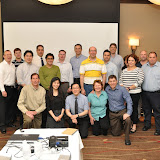
Congratulations to our 2010 Spring Blackbelt graduates!  They have successfully completed the three-month long Blackbelt program. 


More photos can be seen below:

Blackbelt Graduation Spring 2010


Thursday, June 3, 2010

The Amazing "Lean Show" - you have to watch this!

The amazing Lean Show!

As some of you know, our Lean Blackbelt program is the most influential lean program in the world. Many of our clients, including some of our fortune 50 clients, tell us that our lean program is "one of the best, because LSI's programs focus on experiential learning in a way that is so unique."

Our Blackbelt program members, who are graduating tomorrow, presented their final summary today. Some were funny, some were educational, and some were.... well simply amazing. The "wow" factor was impressive in this 2010 spring Blackbelt class. One of the most intriguing presentations was one by Bill Geofroy from Moulding & Millwork, because the entire presentation was delivered in a form of "The Lean Show." Please take a look!


Watch The Lean Show in Educational & How-To  |  View More Free Videos Online at Veoh.com

If you could not access the above link, you may watch the first 10 min of the 14 min show on our youtube as well (youtube only allows 10 min videos). The link for the youtube version of the show is shown below:


Blackbelt Final Presentation

Live from Blackbelt Final Presentation Day!

Wednesday, June 2, 2010

Akio Toyoda Bio

An interesting article from autoweek.com about Akio Toyoda..... take a look:


As Akio Toyoda climbed the ranks at the automaker his grandfather had founded, many Toyota Motor Corp. managers treated the scion with kid gloves.
Not Hiromu Naruse.

Naruse, a certified Master Test Driver who commands cultlike reverence within the company, sneered at the young executive's claim to be a true car guy.

"He told me, 'I don't want to hear what you have to say about cars until you really know how to drive one,' " Toyoda, who became the automaker's president last June, recalled in an interview on the sidelines of this month's Nurburgring 24-hour endurance race.

So Toyoda embarked on a quest to become one of the company's top certified test drivers and its top car critic. That challenge and journey combined to forge Toyoda's management priorities, ones that now are reshaping Toyota in a time of crisis.

Global recalls have led to criticism that Toyota has grown deaf to its customers. Toyoda's personal response to the crisis reflects his emerging management style and draws on his car-guy roots:

-- He demands that executives spend more time focused on product.

-- He pushes for a more hands-on approach throughout the company.

-- He is ordering engineers and designers to spice up the brand's bland image.'Go and see'

By getting behind the wheel and scrutinizing product, the 54-year-old Toyoda believes he is living out the company's guiding principle: "Genchi, Genbutsu"--Japanese for "go and see for yourself."

The key is getting out of the laboratory, Toyoda said.
"Lately, there are a lot of left-brain thinkers at Toyota," he said. "People who like to just logically come to conclusions in a meeting room. We may have had a little too much of that."

Toyoda peppers nearly every public address with talk of "seasoning" the company's vehicles so they're less blah and more "fun to drive." He cites a hybrid sports concept unveiled in January, a low-slung convertible based on the MR2, as the kind of product to expect under his tenure.

"I wanted a car that shows what we are aiming for, something affordable, fun to drive and good for the environment," Toyoda said.
Toyoda's business decisions are often rooted in such instincts. This month's snap decision to team with electric car maker Tesla Motors Inc., for instance, came after he test drove its Roadster in the hills of California and deemed it a hot ride.
But most of his first year in office left little time to pursue such visions.

Toyota posted its first loss in seven decades. An unprecedented quality meltdown triggered the recall of more than 8.5 million vehicles worldwide. The problem, Toyoda said, was that the company grew too fast and took its eye off the product.

"Growth in itself is not bad if you can cultivate the human resources to keep up," Toyoda said. "But I don't want to be the largest company in the world. I want to be the best."

Toyoda's love of cars dates to a childhood surrounded by them. In kindergarten, he drew pictures of himself as a race car driver. Under Naruse, he learned a true appreciation for cars.

Naruse first tried to discourage Toyoda, warning of the inherent dangers in extreme driving. But that only egged him on.

"I love driving," Toyoda said. "So when a strict teacher like Naruse is telling me such stuff, it was hardly discouraging. It was more of a turn-on."
Every week for several years, Toyoda practiced high-speed braking, emergency rollover procedures, pursuit driving and controlled spins until he earned his "advanced" certification.

Toyoda believes it all makes him a better CEO--one who, as Naruse exhorted, understands cars and their boundaries.
Toyoda said: "When it comes to our products, being able to know what is good and what is bad is a special skill."

Some observers disagree. Toyoda's incessant test driving and enthusiasm for racing are often derided in the Japanese press as a distracting hobby. Masaaki Sato, a noted Japanese auto industry watcher who has written such books as The House of Toyota and The Toyota Leaders, describes Toyoda as "the emperor with no clothes" who dodges the details while leaving daily business to his top lieutenants.

Last month, Japan's Foresight magazine suggested that a disaffected cohort at the company wants Toyoda to step down. Although no strong candidate exists to replace Akio Toyoda, Foresight pointed to Tetsuro Toyoda, president of Toyota Industries Corp., a machinery affiliate. Testuro is the son of Eiji Toyoda, a former Toyota Motor president.

Akio Toyoda is aware of his detractors. He said becoming an expert driver was partly an effort to win credibility at the engineering-driven company.

"I'm not an engineer," said Toyoda, who joined the company in 1984 after working at an investment bank and consulting firm.'A common language'

He was looking for "a common language with our engineers. And driving is a tool that can serve as that common language."

His management style has always been about delegating authority to people closest to the action, he says. Underlings describe Toyoda as a big thinker, not a micromanager.

In Japan, his rigid press conference performances usually consist of canned statements. But at Nurburgring, an all-smiles Toyoda showed disarming humility and spontaneity.

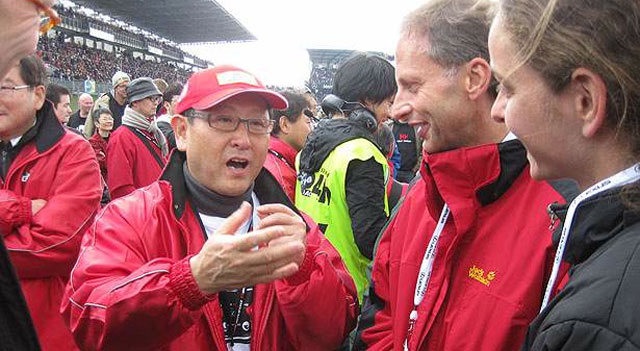
Toyoda, surrounded by fellow car enthusiasts, gladly posed for photos. He snapped his own photos--including plenty of his race team's busty, miniskirted race queens.

A relaxed Toyoda roamed the pits making small talk. During the race, fellow driver Ulrich Bez, CEO of Aston Martin, introduced VIPs to his good friend Akio.

At the post-race party to celebrate the Lexus LFA's 18th-place finish in a field of nearly 200 cars, Toyoda led the beer-and-champagne battle that soaked everyone.

But his charismatic performance likely will remain the hidden alter ego of a low-profile, product-focused car guy. "I've been called media-shy, and that's not going to change," Toyoda said. "Here's why: The main actor is the vehicle."Hands-on scion

A personal look at Akio Toyoda

Age: 54
Education: Keio University, bachelor's degree, 1979; Babson College, MBA, 1982

Childhood dream: To be a race car driver

First car: Used 4-door Corolla GT; "I was taken with the name GT."

Family: Married, 1 daughter and 1 son

Racing history: 2 appearances at Nurburgring 24-hour endurance race

Other sport: Played on Japanese national field hockey team

Motto: "I can't accomplish anything by myself."

Nifty Lexus LFA Commercial

Thinking about getting a new car?  What about the new Lexus LFA?


See what happens when Lexus tunes the 552 horespower V10 engine of the LFA with the precision of a musical instrument. Discover what else is possible at www.lexus.com/thepursuit.

Tuesday, June 1, 2010

IDEON Kaizen


We wanted to just say "thank you" in advance to IDEON for hosting our kaizen.
We hope our Blackbelts will produce meaningful results that can make a difference.

Our Support Staff Mayu sits on a chair made
from corrugated cardboard.... at IDEON.

Extreme Kaizen Update

The Blackbelts have started their "extreme kaizen" program this week at a packaging company called IDEON, which is undergoing lean journey.  Although fairly new to lean, IDEON has a great culture and mindset that makes them naturally lean, so the Blackbelts have to think a bit deeper to uncover true "gems."


Brainstorming and visioning have resulted in four teams which will begin problem solving shortly.  Best wishes Blackbelts!

Sunday, May 30, 2010

Photos from LSI Japan Lean Tour May 2010

Finally - after being back from Japan for about two weeks - I was able to re-organize the various photos taken by LSI in Japan.  Other members of the program took photos too (perhaps in thousands!) but these are the ones LSI took during the trip.

Take a look! (we apologize that some photos are not oriented correctly).

LSI Japan Lean Tour Group at the Toyota Motomachi Factory in Toyota City

click the link below for the entire photo album....

Japan Lean Tour May 2010 Photos

Saturday, May 29, 2010

Lean Extreme Makeover Week

This week, LSI will be busy facilitating our most advanced problem solving kaizen. Simply called the Lean Problem Solving (LPS) methodology, our LPS program has been rated as "the best kaizen methodology" by a variety of clients who have taken this course.  "It's so effective, so advanced, but so simple," is one comment made by a senior lean director at a fortune 50 company recently in Asia, after taking this program.

Part of LSI's Blackbelt and Executive program, the LPS kaizen will be taking place Monday through Wednesday at a packaging company. It is described as "Extreme Makeover Kaizen" because participants only have 3 days to overhaul a company and develop solutions.  Stay tuned for day-to-day update this week!


What is LPS?

LPS is a proven problem solving technique touted in our industry as the most effective methodology for achieving business success.

While LPS – at first glance – appears to be a collection of various lean tools, but it is far more than that . . .


It is a disciplined approach that combines the best methods and tools into a single, standardized “hybrid” methodology that virtually guarantees results each and every time.

Lean Sensei’s LPS methodology merges the best from world-class companies to deliver the most compelling problem solving technique ever.

Six Sigma is Out. Lean is In.

I came across this interesting article from Bloomberg, and thought that I should share with everyone....


Six Sigma is Out. Extreme Lean Manufacturing Is In


Source:  Bloomberg

U.S. companies from food makers to heavy industry to banks are cutting costs by gearing output precisely to demand

When surgical device maker Conmed (CNMD) decided in 2007 to streamline production, executives explored the usual options. The Utica (N.Y.) company could ship more manufacturing to China. Or it could invest in automation.

Conmed chose a third path instead: It completely overhauled its production. Long assembly lines at its 600-worker Utica plant have given way to compact U-shaped workstations. Piles of plastic boxes stuffed with enough parts to last weeks have been replaced by just a few bins containing the exact number of parts needed.

No longer do workers furiously crank out products that languish in warehouses. Instead they build only as many as customers need at the time. Conmed calculates that every 90 seconds hospitals worldwide use one of its disposable devices for inserting and removing fluids around joints during orthoscopic surgery. So that's precisely how long it takes for a new one to roll off its assembly line. A growing number of products, such as instruments for cutting bone, are assembled only after hospitals place orders. "The goal is to link our operations as closely as possible to the ultimate buyer of the product," says David A. Johnson, vice-president for global operations.

Lean manufacturing—producing goods with minimal waste of time, materials, and money—was pioneered by Japanese companies such as Toyota Motor (TM) decades ago. Now a growing number of U.S. businesses are trying a more extreme form of lean. Besides making factories superefficient, they are gearing output to current demand rather than three- to six-month forecasts.

In capital-starved times, companies can ill afford to tie up cash by letting parts and finished goods lie idle in inventory. And these days, even if companies place orders, there's no guarantee they'll get the financing to complete the purchase. In most past recessions, notes Richard Seaman, CEO of Seaman Corp., a Wooster (Ohio) maker of heavy fabrics for industry and construction, companies could generally predict demand for the next month with an accuracy within 5%. "In the past four or five months," he says, "there has been a sea change." Converting to very lean manufacturing helped the company adjust to the new environment. It used to fill large orders in six weeks. Now some fabrics are out the door 48 hours after an order is placed.

TYING EVERYONE IN

The next challenge is getting a clearer picture of what's happening on the customer's end. Celestica (CLS), the $7.7 billion contract manufacturer of electronics gear, is rolling out a system it calls Liveshare. Within two years, the company hopes Liveshare will let all of Celestica's customers, global factory network, and 4,000 suppliers share real-time data on demand, production, inventories, and shipping for every product. Some suppliers already use Liveshare, but the plan is to include major electronics buyers as well.

Say a purchase manager for Best Buy (BBY) needs supplies of a hot video game console assembled by Celestica. Today, most buyers would use phone, fax, and e-mail to assess how quickly Celestica could deliver. But a buyer checking Celestica's online database would see up-to-the-minute diagrams showing how many consoles are rolling off production lines. And Celestica could peer into Best Buy's inventory and sales data to estimate how many consoles the chain needed. "What a tremendous breakthrough this would be," says CEO Craig Muhlhauser.

Not all goods can or should be built to order. Some 80% of Conmed's $742 million in 2008 sales came from disposables sold by the millions to hospitals, where demand is fairly steady. For mass-produced items, it bases hourly output targets on forecasts updated every few months. Before, mass quantities of goods sat in warehouses until they were sold.

At Conmed's Utica plant, the assembly area for fluid-injection devices once consumed 3,300 square feet and had $93,000 worth of parts on hand. Now it covers one-fifth that space and stocks just $6,000 worth of parts. Output per worker is up 21%. Do the improvements yield savings superior to what could be had in China? Wages there, though vastly lower, are largely offset by the costs of long lead times, inventory pileup, quality problems, and unforeseen delays. "If more U.S. companies deploy these production methods," says Johnson, "we can compete with anybody."

Wednesday, May 26, 2010

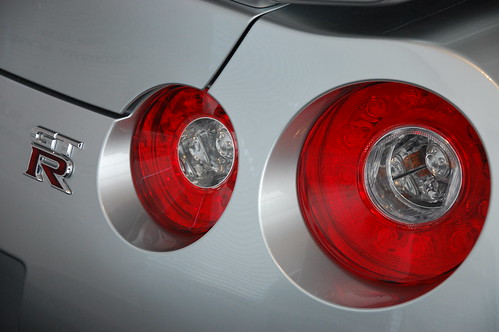
Which car is this?

Can you guess?  It was our Blackbelt's favorite car in Japan!

Tuesday, May 25, 2010

Greenbelt Vancouver Class of Spring 2010 Graduates!

Greenbelt class of 2010 Spring Vancouver

It is with our honor to graduate another group of talented lean champions from our most popular and highly acclaimed Lean Greenbelt Certification.

Consisting of people from all across the country and from various industries (manufacturing, health care, etc), this diversified group of class delivered an impressive "final Greenbelt video."  Each Greenbelt class is tasked with designing, developing, and creating a short film summarizing their accomplishments and performance throughout the class.  With the theme of "Biggest Leaner," this spring 2010 class created what could very well be one of the best videos we've seen.  Everyone participated in the video, but special thanks go to Francesca Baggio, Tom Meierhoff, and Marianne Stewart who are the masterminds behind this latest video.

A number of participants said to us,"It's life changing. It's not like any other course or program we've ever taken.  How can we even explain what this program is to others .... they won't understand the true meaning and purpose of the Greenbelt until they take it!"

Also, we want to recognize the three highest ranking graduates from this class:  Bob Smith, Mike Nunn and Marianne Stewart. 

Photos the top 3 graduates and those who helped with the GB video
from left: Mike, Marianne, Bob, Francesca, Tom, and David Chao of LSI

The Greenbelt videos have been split up into two parts because youtube.com only allows max of 10 min video, and this video is 18 min long in total.

Greenbelt Special Video Part A (of two parts)


Greenbelt Special Video Part B (final)

Sunday, May 23, 2010

Definition of Lean Leadership


While the definition of lean in the previous post tends to focus heavily on "tools," there is one section in the wikipedia that talks about lean leadership. Again, I don't agree with everything in the wikipedia, but we do appreciate them mentioning our name (we are honored!).  Take a look at their definition of lean leadership as it is spelled out in the lean manufacturing section of the wikipedia.com.

Lean leadership: source - wikipedia.com (under "lean manufacturing")


The role of the leaders within the organization is the fundamental element of sustaining the progress of lean thinking. Experienced kaizen members at Toyota, for example, often bring up the concepts of Senpai, Kohai, and Sensei, because they strongly feel that transferring of Toyota culture down and across Toyota can only happen when more experienced Toyota Sensei continuously coach and guide the less experienced lean champions. Unfortunately, most lean practitioners in North America focus on the tools and methodologies of lean, versus the philosophy and culture of lean. Some exceptions include Shingijitsu Consulting out of Japan, which is made up of ex-Toyota managers, and Lean Sensei International based in North America, which coaches lean through Toyota-style cultural experience.

One of the dislocative effects of Lean is in the area of key performance indicators (KPI). The KPIs by which a plant/facility are judged will often be driving behaviour, because the KPIs themselves assume a particular approach to the work being done. This can be an issue where, for example a truly Lean, Fixed Repeating Schedule (FRS) and JIT approach is adopted, because these KPIs will no longer reflect performance, as the assumptions on which they are based become invalid. It is a key leadership challenge to manage the impact of this KPI chaos within the organization.
Similarly, commonly used accounting systems developed to support mass production are no longer appropriate for companies pursuing Lean. Lean Accounting provides truly Lean approaches to business management and financial reporting.

After formulating the guiding principles of its lean manufacturing approach in the Toyota Production System (TPS) Toyota formalized in 2001 the basis of its lean management: the key managerial values and attitudes needed to sustain continuous improvement in the long run. These core management principles are articulated around the twin pillars of Continuous Improvement (relentless elimination of waste) and Respect for People (engagement in long term relationships based on continuous improvement and mutual trust).

This formalization stems from problem solving. As Toyota expanded beyond its home base for the past 20 years, it hit the same problems in getting TPS properly applied that other western companies have had in copying TPS. Like any other problem, it has been working on trying a series of countermeasures to solve this particular concern. These countermeasures have focused on culture: how people behave, which is the most difficult challenge of all. Without the proper behavioral principles and values, TPS can be totally misapplied and fail to deliver results. As one sensei said, one can create a Buddha image and forget to inject soul in it. As with TPS, the values had originally been passed down in a master-disciple manner, from boss to subordinate, without any written statement on the way. And just as with TPS, it was internally argued that formalizing the values would stifle them and lead to further misunderstanding. But as Toyota veterans eventually wrote down the basic principles of TPS, Toyota set to put the Toyota Way into writing to educate new joiners. [24]

Continuous Improvement breaks down into three basic principles:

Challenge : Having a long term vision of the challenges one needs to face to realize one's ambition (what we need to learn rather than what we want to do and then having the spirit to face that challenge). To do so, we have to challenge ourselves every day to see if we are achieving our goals.

Kaizen : Good enough never is, no process can ever be thought perfect, so operations must be improved continuously, striving for innovation and evolution.

Genchi Genbutsu : Going to the source to see the facts for oneself and make the right decisions, create consensus, and make sure goals are attained at the best possible speed.

Respect For People is less known outside of Toyota, and essentially involves two defining principles:

Respect Taking every stakeholders' problems seriously, and making every effort to build mutual trust. Taking responsibility for other people reaching their objectives. Thought provoking, I find. As a manager, I must take responsibility for my subordinates reaching the target I set for them.

Teamwork : This is about developing individuals through team problem-solving. The idea is to develop and engage people through their contribution to team performance. Shop floor teams, the whole site as team, and team Toyota at the outset.

Definition of Lean Manufacturing


Do you know where you can find a great definition of Lean Manufacturing?  It turns out that wikipedia, surprisingly, has an excellent outline of what lean manufacturing actually means.  I've included the first few paragraphs below, and the rest can be seen at the link below. I don't completely agree with everything in the wikipedia, since it tends to focus on "tools" vs "philosophy."  As you know, LSI believes that the foundation for lean is "culture and philosophy first, tools second," where as the wikipedia tends to emphasize too much on tools side.  Regardless, the summary is useful for those people who want to understand different viewpoints (keep in mind that this definition is also heavily biased towards manufacturing, even though lean applies to virtually every type of industries).

Lean Manufacturing Definition

By the way, there are only a few companies mentioned in this wikipedia definition.... guess where LSI is mentioned? (you'll need to read the entire link to find out where...!).

Lean Overview - source: wikipedia.com

Lean principles come from the Japanese manufacturing industry. The term was first coined by Bob Hartman in a Fall 1988 article, "Triumph of the Lean Production System," published in the Sloan Management Review and based on his master's thesis at the MIT Sloan School of Management.[4] Krafcik had been a quality engineer in the Toyota-GM NUMMI joint venture in California before coming to MIT for MBA studies. Krafcik's research was continued by the International Motor Vehicle Program (IMVP) at MIT, which produced the international best-seller book co-authored by James Womack, Daniel Jones, and Daniel Roos called The Machine That Changed the World.[1] A complete historical account of the IMVP and how the term "lean" was coined is given by Holweg (2007).

For many, Lean is the set of "tools" that assist in the identification and steady elimination of waste (muda). As waste is eliminated quality improves while production time and cost are reduced. Examples of such "tools" are Value Stream Mapping, Five S, Kanban (pull systems), and poka-yoke (error-proofing).

There is a second approach to Lean Manufacturing, which is promoted by Toyota, in which the focus is upon improving the "flow" or smoothness of work, thereby steadily eliminating mura ("unevenness") through the system and not upon 'waste reduction' per se. Techniques to improve flow include production leveling, "pull" production (by means of kanban) and the Heijunka box. This is a fundamentally different approach from most improvement methodologies, which may partially account for its lack of popularity.

The difference between these two approaches is not the goal itself, but rather the prime approach to achieving it. The implementation of smooth flow exposes quality problems that already existed, and thus waste reduction naturally happens as a consequence. The advantage claimed for this approach is that it naturally takes a system-wide perspective, whereas a waste focus sometimes wrongly assumes this perspective.

Both Lean and TPS can be seen as a loosely connected set of potentially competing principles whose goal is cost reduction by the elimination of waste.[6] These principles include: Pull processing, Perfect first-time quality, Waste minimization, Continuous improvement, Flexibility, Building and maintaining a long term relationship with suppliers, Autonomation, Load leveling and Production flow and Visual control. The disconnected nature of some of these principles perhaps springs from the fact that the TPS has grown pragmatically since 1948 as it responded to the problems it saw within its own production facilities. Thus what one sees today is the result of a 'need' driven learning to improve where each step has built on previous ideas and not something based upon a theoretical framework.

Toyota's view is that the main method of Lean is not the tools, but the reduction of three types of waste: muda ("non-value-adding work"), muri ("overburden"), and mura ("unevenness"), to expose problems systematically and to use the tools where the ideal cannot be achieved. From this perspective, the tools are workarounds adapted to different situations, which explains any apparent incoherence of the principles above.

Origins

Also known as the flexible mass production, the TPS has two pillar concepts: Just-in-time (JIT) or "flow", and "autonomation" (smart automation).[7] Adherents of the Toyota approach would say that the smooth flowing delivery of value achieves all the other improvements as side-effects. If production flows perfectly then there is no inventory; if customer valued features are the only ones produced, then product design is simplified and effort is only expended on features the customer values. The other of the two TPS pillars is the very human aspect of autonomation, whereby automation is achieved with a human touch.[8] The "human touch" here meaning to automate so that the machines/systems are designed to aid humans in focusing on what the humans do best. This aims, for example, to give the machines enough intelligence to recognize when they are working abnormally and flag this for human attention. Thus, in this case, humans would not have to monitor normal production and only have to focus on abnormal, or fault, conditions.

Lean implementation is therefore focused on getting the right things to the right place at the right time in the right quantity to achieve perfect work flow, while minimizing waste and being flexible and able to change. These concepts of flexibility and change are principally required to allow production leveling, using tools like SMED, but have their analogues in other processes such as research and development (R&D). The flexibility and ability to change are within bounds and not open-ended, and therefore often not expensive capability requirements. More importantly, all of these concepts have to be understood, appreciated, and embraced by the actual employees who build the products and therefore own the processes that deliver the value. The cultural and managerial aspects of Lean are possibly more important than the actual tools or methodologies of production itself. There are many examples of Lean tool implementation without sustained benefit, and these are often blamed on weak understanding of Lean throughout the whole organization.

Lean aims to make the work simple enough to understand, do and manage. To achieve these three goals at once there is a belief held by some that Toyota's mentoring process (loosely called Senpai and Kohai), is one of the best ways to foster Lean Thinking up and down the organizational structure. This is the process undertaken by Toyota as it helps its suppliers improve their own production. The closest equivalent to Toyota's mentoring process is the concept of "Lean Sensei," which encourages companies, organizations, and teams to seek outside, third-party experts, who can provide unbiased advice and coaching, (see Womack et al., Lean Thinking, 1998).

There have been recent attempts to link Lean to Service Management, perhaps one of the most recent and spectacular of which was London Heathrow Airport's Terminal 5. This particular case provides a graphic example of how care should be taken in translating successful practices from one context (production) to another (services), expecting the same results. In this case the public perception is more of a spectacular failure, than a spectacular success, resulting in potentially an unfair tainting of the lean manufacturing philosophies.

continue reading at wikipedia.com (click link below) . . .
 
Lean

Thursday, May 20, 2010

Breaking News: Toyota to "Resurrect" NUMMI with Tesla Motors


Toyota and Tesla to partner on EV production in California

Source: Autoblog

California governor Arnold Schwarzenegger, Tesla CEO Elon Musk and Toyota CEO Akio Toyoda held a joint press in Palo Alto, California to announce that the two companies would be collaborating on electric vehicle development and production, with Tesla will taking over the recently closed NUMMI factory in Fremont, CA to produce the Model S sedan.

Toyota will invest $50 million for a private placement of Tesla common stock and the state of California will provide a sales tax abatement to Tesla for capital equipment expenditures to tool up the plant. Musk estimated that the abatement will amount to about $20 million over the next several years.

According to Musk, production of the Model S will bring about 1,000 employees back to the NUMMI plant to produce about 20,000 cars a year at first, and as the facility expands – possibly to include the production of more models – it could employ up to 10,000 workers. Musk revealed that some employees have already been rehired, but was non-committal on the subject of union representation. NUMMI was the only Toyota plant in North America that was unionized.

An additional benefit to Tesla from this deal is that it will be able to take advantage of the Toyota production system and possibly some of Toyota's suppliers. That's sure to help Tesla avoid many of the logistical problems that hampered early Roadster production and costs.

Production of the Model S is still planned to start in 2012 and Musk said more advanced prototypes would be revealed later this year. No decisions have been made yet about additional vehicles to be produced at the plant which previously had a capacity of more than 300,000 vehicles a year.

Official release from Toyota below:

Tesla Motors and Toyota Motor Corporation Intend to Work Jointly on EV Development, TMC to Invest in Tesla

Source: Toyota News

May 20, 2010 - Palo Alto, California, U.S.A. — Tesla Motors, Inc. (Tesla) and Toyota Motor Corporation (TMC) today announced that they intend to cooperate on the development of electric vehicles, parts, and production system and engineering support.

The two companies intend to form a team of specialists to further those efforts. TMC has agreed to purchase $50 million of Tesla’s common stock issued in a private placement to close immediately subsequent to the closing of Tesla’s currently planned initial public offering.

“I sensed the great potential of Tesla’s technology and was impressed by its dedication to monozukuri (Toyota’s approach to manufacturing),” said TMC President Akio Toyoda. “Through this partnership, by working together with a venture business such as Tesla, Toyota would like to learn from the challenging spirit, quick decision-making, and flexibility that Tesla has. Decades ago, Toyota was also born as a venture business. By partnering with Tesla, my hope is that all Toyota employees will recall that ‘venture business spirit,’ and take on the challenges of the future.”

“Toyota is a company founded on innovation, quality, and commitment to sustainable mobility. It is an honor and a powerful endorsement of our technology that Toyota would choose to invest in and partner with Tesla,” said Tesla CEO and cofounder Elon Musk. “We look forward to learning and benefiting from Toyota’s legendary engineering, manufacturing, and production expertise.”

TMC has, since its foundation in 1937, operated under the philosophy of “contributing to the society through the manufacture of automobiles,” and made cars that satisfy its many customers around the world. TMC introduced the first-generation Prius hybrid vehicle in 1997, and produced approximately 2.5 million hybrids in the twelve years since. Late last year, TMC started lease of Prius Plug-in Hybrids, which can be charged using an external power source such as a household electric outlet. The company also plans to introduce EVs into the market by 2012.

Tesla’s goal is to produce increasingly affordable electric cars to mainstream buyers – relentlessly driving down the cost of EVs. Palo Alto, CA-based Tesla has delivered more than 1000 Roadsters to customers in North America, Europe and Asia. Tesla designs and manufactures EVs and EV powertrain components. It is currently the only automaker in the U.S. that builds and sells highway-capable EVs in serial production. The Tesla Roadster accelerates faster than most sports cars yet produces no emissions. Tesla service rangers make house calls to service Roadsters.

Japan's Contrasting Buildings


Japan was both educational and inspirational.  I thought I would share two contrasting photos from the trip.... One from Asakusa where Japan's traditional elements are clearly visible. The other photo is from Shinjuku, where some of the tallest buildings can be found.  The round building you see is called - appropriately - the "cocoon" building!

Tuesday, May 18, 2010

Latest 2010 Toyota Information


This is hot off the press!  Toyota has just released the latest 2010 summary information about its company, its operations, and its products. The PDF document is called the Toyota 2010 Databook and it's filled with interesting information.

Please take a look - not too many people know about it.

Toyota Databook 2010

Monday, May 17, 2010

Toyota Plant Group Photo

This photo just arrived from Toyota office! (they took the photo for us)
Our Japan Lean Program members pose at Toyota's Motomachi Plant: undoubtly, one of the most important visits during this program.  Visiting "Toyota City" is a milestone for many lean enthusiasts.

Sunday, May 16, 2010

Funny Moments - Unforgettable


As I begin to wind down here in Japan and prepare to return to North America, I couldn't help but take another look at some of the photos we took while we were in Japan.  We took literally hundreds - maybe thousands - of photos but these three were the funniest by far.   Thanks everyone for the wonderful memories and great time.  We leave Japan with reminders about the importance of "hansei", "respect" and "teamwork." 

PS Can you guess who the funny guy with fake mustache is?  (answer: street vendor in Asakusa who sells Japanese donuts - he always "dresses up" for us when taking photos!)

Saturday, May 15, 2010

Doing WAVE in Japan

Our 2010 Japan Lean Program participants perform the "wave" during a beautiful lunch at a traditional Japanese restaurant.  The food was super healthy (mostly seafood and vegetables, steamed or boiled with special Japanese flavors) and people loved the restaurant.


Final day with Toyota and Denso

LSI's Japan Lean Program ended Friday with an important visit to Toyota's renowned Motomachi factory and Toyota's largest supplier, Denso Corporation.  The Motomachi factory is the "mother plant" for many plants around the world, and therefore Toyota employees are often sent there to be trained.  The massive global training center is located beside the Motomachi factory.  Everything from kanban to visual boards were observed during the two-hour visit, and the participants all felt that they "achieved a milestone" by visiting a Toyota plant at Toyota City.  We also visited the Toyota Kaikan (pavillion) where we watched the Toyota robot play a trumpet.

For a glimpse of the Japan Lean Tour program, watch our short overview video:


Thursday, May 13, 2010

Nissan Accomplishments at Oppama Plant

Today, the LSI team visited two Nissan plants:  Oppama car factory and Yokohama engine plant. Oppama is where the latest Nissan Leaf electric car is being built.

Though this document is not the most recent presentation, it provides incredible details about what Nissan has accomplished at the Oppama Plant here in Japan.  Already one of the best plants in the world, looking through the presentation provides us with an insight about what was accomplished.


Please take a look at the PDF file provided by Nissan:

Nisssan Oppama Presentation

Toyota Museum

Toyota's Commemorative Museum of Industry and Technology (we call it Toyota Technology Museum for short) in Nagoya is a mind-boggling museum with massive information about Toyota.  Everything from the history of Toyota to today's modern technology is showcased. Our Japan Lean Tour group spent an afternoon learning about Toyota Way in this historic site!


Take a look at their virtual tour:

Toyota Technology Museum Tour

Nissan Oppama Plant


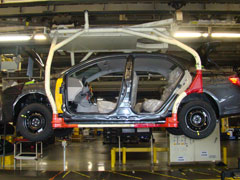
Yesterday, we viewed Nissan's engine plant.  And today, we complete the "package" by visiting the Oppama car plant in Yokohama.  Designed to produce cars every minute (it takes 16 hrs to create the entire car), the Oppama plant is a highly efficient plant that utilizes flow production principles. Our LSI team learned a great deal!

Sashimi!

Our Japan Lean Program cannot be complete without some great Japanese meals.
Fresh from the nearby Tsukiji fish market, the Sashimi brings subtle flavors.

Wednesday, May 12, 2010

LSI Team visits Nissan Engine Plant


Today, LSI Japan program participants visited the world-renowned Nissan Engine Plant in Yokohama.  In addition to producing award winning engines for a variety of cars, this plant also hand-produces the incredible engine for the Nissan GT-R high performance sports car.  Built inside a "clean room," the engine for GT-R is built by one operator from the beginning to the end, resulting in a precision product.  Take a look at this factory brochure to get full information about the plant:

Nissan Engine Factory Brochure

Tuesday, May 11, 2010

Toyota Records Surprising Profit

Toyota Posts $2.2 Billion Annual Profit


Source: New York Times

TOKYO — Toyota roared back to a profit in the fiscal year that just ended and forecast a further jump in earnings on Tuesday, shaking off the effects of a crippling global slowdown and a safety scandal that has threatened to ruin the Japanese automaker’s cherished reputation for quality.

Toyota thwarted a third consecutive year in the red thanks partly to a strong performance in the three months through March — the period when the Japanese automaker recalled millions of cars and was under the intense scrutiny of consumers and governments around the world .

Net profit for the three months was ¥112 billion, or $1.2 billion, compared with a ¥766 billion loss the year before, as the automaker slashed costs and introduced aggressive sales incentives that lured customers back to its showrooms.

“After taking over amid a storm, I wanted to do anything to avoid a third straight year in the red,” Toyota’s president Akio Toyoda, who took helm at the company in June 2009, said after the earnings announcement. “These results follow tough and anguishing decisions” on the part of Toyota’s management, he said, referring to the automaker’s dismissal of workers both in Japan and overseas amid company-wide cost cuts.

Quarterly revenue jumped to ¥5.28 trillion from ¥3.54 trillion the previous year, when car sales slumped in the midst of the global financial crisis. Revenues showed an especially strong rebound in the dynamic Chinese market and in the United States, while sales in Europe and Japan continued to slump.
Toyota estimated net income to rise to ¥310 billion in the business year through the end of March 2011, a conservative estimate. It expects to sell 7.29 million units, or 53,000 more than it sold this year, the automaker said. Toyota also announced a cash dividend for the full fiscal year of ¥45 per share.

For the past business year that just ended, net income rebounded to ¥209.4 billion, or $2.2 billion, from a loss of ¥437 billion the previous year.

Live Sumo

Right after visiting Toyota Logistics, our LSI Japan Lean team had a bit of free time to visit and watch the world-famous Sumo live!  We were speechless.

Big thanks to Doddy from Alpha for taking some photos for us!

LSI visits Toyota Logistics and Forklift in Japan

Perhaps the best material management and logistics company in the world, Toyota L&F (logistics and forklift) provides full turn key service for designing, implementing and managing a variety of material handling system.  LSI visited this world-class traininng center and spent several hours with our Japan Lean Tour group to learn the latest technique about advanced kaizen, 5S, inventory management and supply chain.


Monday, May 10, 2010

Poka Yoke Parking Lot

Why bother giving "tickets" for expired parking meters if you can just prevent the driver from taking off in the first place until the money is paid?  Tokyo's "poka yoke" (error proofing) parking system prevents unpaid parking problem by simply "locking" the car with a computerized plate mechanism that is raised when the car is parked.  The only way the driver can actually leave the parking spot is to pay the full amount due, which is tracked by a sensor/timer when the car is first parked.  Completely automated and error proof ... only in Japan!

Tokyo Visit


Some of the members of LSI's Japan Lean Tour program arrived early to enjoy Japan.  Bill and Rich from Moulding and Millwork pose for a shot with LSI's Bob inside Tokyo's famous subway.  They are heading to Ginza after visiting Shinjuku.


Sunday, May 9, 2010

LSI in Japan!

Shibuya

Tsukiji fish market

We are in Japan to begin the Japan Lean Tour.  Japan is a country like no other in the world. It built its economic power through manufacturing over the past several decades, earning a reputation around the world as the “lean specialist.”


Even though many lean best practices can be found throughout North America, the truly “serious” lean practitioners still find that Japan is the only place that can showcase lean implementation in its purest form. This is partly because lean can be seen in everyday life in Japan, not just in production or engineering. People who travel to Japan are fascinated by the fact that even restaurants and gas stations utilize lean in a way North Americans have not imagined. It’s difficult to truly appreciate lean until you have seen and experienced Japan hands-on.

Lean Sensei International is proud to have taken a group of North American lean practitioners to Japan for the past several years. We have taken more than 500 people to Japan.The program is intentionally designed to provide both educational and cultural exposure to Japan through various plant tours and historical sites. Tours have been arranged with such big hitters as Toyota and its suppliers, but also with smaller players that can showcase different levels of lean implementation.

David Chao, who was born and raised in Japan and therefore is fluently bilingual, will accompany the group and provide cultural and lean insights throughout the trip based on his 20-year lean experience Just about everything is taken care of while you are there and two bilingual specialists will accompany the group for the duration of the trip.  On this trip, we also have Joey Higuchi and Bob Low in this group.

Japan Lean Tour is part of Lean Sensei International’s “Lean Executive Program.” and also a standard module in our blackbelt program.

Thursday, May 6, 2010

LSI ready for Japan Trip

Next week is the beginning of LSI's most respected and most admired program of all: Japan Lean tour. Designed to immerse participants into "evryday lean living", people will learn so much about the true meaning of lean that it will be overwhelming. Schedule includes benchmarking trip to Toyota, Dento, Nissan, Olympus, and Toyota Forklift. It will be life changing! Expect a lot of microblogging via my international blackberry I am using....


Saturday, May 1, 2010

Malcolm Gladwell

Did you know that Malcom Gladwell, the author of the books Blink, Tipping Point, and the Outliers, is going to be speaking at this year's AME Lean Conference in Baltimore?  He is a fascinating speaker and writer, though he has an "unusual" haircut!  Take a look at some of his speaking engagements on youtube:


Friday, April 30, 2010

TOYOTA NORTH AMERICAN QUALITY ADVISORY PANEL

LEADING SAFETY AND QUALITY EXPERTS NAMED TO TOYOTA NORTH AMERICAN QUALITY ADVISORY PANEL


Industry, Government, Education and Non-Profit Leaders Join Former U.S. Secretary of Transportation Rodney Slater to Advise on Quality and Safety

Source: Toyota News

NEW YORK, NY April 29, 2010 – Former U.S. Secretary of Transportation Rodney E. Slater announced today the appointment of six highly-regarded safety and quality experts to Toyota's independent North American Quality Advisory Panel, completing the Panel's membership. The distinguished roster of experts, with experience spanning the corporate, government, education and non-profit sectors, join Secretary Slater, who was named in March to lead the new Panel.

Secretary Slater was instrumental in the selection and approval of the newly-appointed Panel members. The full Panel includes:

· Rodney E. Slater, former U.S. Secretary of Transportation;

· Norman Augustine, former chairman and CEO, Lockheed Martin Corporation;

· Patricia Goldman, former Vice-Chairman, National Transportation Safety Board;

· Mary Good, Dean of Engineering and Information Technology, University of Arkansas at Little Rock, and former President, American Association for the Advancement of Science (AAAS);

· Roger Martin, Dean, Rotman School of Management;

· Brian O’Neill, former President, Insurance Institute for Highway Safety; and

· Sheila Widnall, Professor, MIT and former Secretary of the U.S. Air Force.

This independent group of experts will advise Toyota’s North American affiliates on quality and safety issues, working closely with the company’s leadership team and the newly-formed North American Quality Task Force, led by Chief Quality Officer, Steve St. Angelo. Panel members will have unfettered access to information concerning Toyota’s quality and safety procedures and direct communication with Toyota Motor Corporation President Akio Toyoda as well as with the newly-formed Special Committee for Global Quality, led by Mr. Toyoda. The Panel will also be able to commission additional outside reviews and will have the resources necessary to pursue its mandate.

“Toyota is in the midst of a significant global effort to strengthen our quality assurance operations and set a new, higher standard for vehicle safety and reliability. We are committed to taking the steps necessary to exceed customer expectations in every way possible,” said Mr. St. Angelo. “Engaging the experience and counsel of independent experts is a critical component of this process. We are honoured to have each of these accomplished leaders partner with us to help ensure that we achieve our goals.”

“I’m pleased to be working with a group of such distinguished leaders. Each panel member is widely respected for his or her individual background, expertise and capabilities – in business, transportation, government and safety,” said Secretary Slater. “Taken together, this group has the diversity of experience and depth of knowledge needed to offer sound advice, guidance and counsel to Toyota regarding its safety and quality protocols.”
The Panel's immediate priority is to develop an in-depth understanding of Toyota's safety and quality control processes, including the significant steps the company has already taken to further improve its quality assurance capabilities. The Panel has already begun on-site reviews of the company's key operating facilities, plants and technical centres around North America. In May, the Panel will travel to Japan, where they will meet with senior company executives, including President Akio Toyoda, and visit the company's quality, research and development, and technical centres.

As one of its first actions, the Panel will undertake an evaluation of the electronic throttle control system (ETCS-i) installed in Toyota and Lexus vehicles and its findings will be made public. For this evaluation, the group will have full access to the results of extensive testing previously and currently conducted by Toyota as well as the comprehensive, independent study being undertaken for Toyota by Exponent, a leading engineering and scientific consulting firm based in Palo Alto, California. As part of its on-site reviews, the Panel will visit Exponent's facilities and meet with the firm's engineers.

Thursday, April 29, 2010

Our lean programs


Considered by our clients to be the most effective and experiential lean certification programs in the industry, LSI offers two tracks of certifcations: Lean Belt Certification for people who want to become lean champions and specialists ("lean implementors and leaders"), and Executive Lean Certification for those who manage, lead, or strategize lean ("lean sponsors and ambassadors"). Japan Lean Tour is the "ultimate" benchmarking trip, in which you visit and see some of the best plants in the world.

Did you know that we offer more lean certification programs than any other company in Canada? For more info, please see our website:

LSI Certification Programs

Sunday, April 25, 2010

Secret Toyota Site


Well, actually not really a secret site, but this is the corporate website for Toyota headquarters that is not normally publicized.  It is in English but most people are not aware that this site even exists. It provides many insights about the current affairs at Toyota and also contains latest information about Toyota's financial/technical situation.

Take a look.....

Toyota Corporate Site

And if you click the link below, you will see the latest video/audio/PDF presentations by the president Akio Toyoda regarding their latest thoughts on the quality issues.

Toyota Presentation

Wednesday, April 21, 2010

Master Blackbelt

Did you know that LSI has a Master Blackbelt Program?  Available only by invitation and limited to one or two people per year, the MBB candidates have to go through an extensive internship with LSI that are "out of this world", according to one MBB who graduated previously.

The attached video, created by a former MBB, shows some of the activities they go through.  Funny and somewhat informative, it provides insight into what the MBB program is about. This is an oldie, but it's worth watching.

Sunday, April 18, 2010

Tulsa Oklahoma Graduation for Greenbelt!

It's a busy month, with so many people graduating from our Greenbelt Certification Program.  This past week, our US Greenbelt participants in Tulsa, Oklahoma completed their busy program to graduate successfully.  A big thank you to our Bob for facilitating this week and to everyone who contributed to the program!


Thursday, April 15, 2010

Manitoba Greenbelt Graduation

LSI offers Greenbelt in numerous locations, including Calgary, Toronto, Tulsa (Oklahoma), Winnipeg, and of course, here in Vancouver.

But outside Vancouver, the Winnipeg Greenbelt class is the longest running Greenbelt.

Just recently, another amazing class of Greenbelt in Winnipeg, Manitoba, graduated. Congratulations!


Wednesday, April 14, 2010

Our most viewed video on youtube.com

Did you know that this video - from the Japan Lean Tour 2008 - is our most viewed video on youtube? It has more than 9000 views! I am not sure why it gets so much hits, but perhaps it's because we had fun creating it and our passion shows through.

It is a summary of the Japan Lean Tour in 2008, in which our Lean Blackbelts participated in a creative "fear factor" lean show. LSI has taken more than 350 people to Japan through this program so far!

Sunday, April 11, 2010

Lean Trek

The winter class of 2010 Greenbelt has created a special video summarizing their accomplishment, but in the form of Star Trek spoof! This is the best video ever created by a Greenbelt class in the past decade!

Congratulations to the entire class of Winter 2010, which received the Lean Greenbelt Certification!

Thursday, April 8, 2010

More from today's Greenbelt class

Our last presenter at Greenbelt class of winter 2010 delivered a short but effective ice breaker.  We all practiced some kung-fu moves!  Thanks Danny!

Vancouver Greenbelt Live!

Live from Vancouver Greenbelt Winter class of 2010

I am microblogging from our great class of Greenbelt Winter 2010, who are graduating this week. They are doing their presentation today, providing information about what they learned and what they accomplished.  23 people are in this about-to-graduate class of talented lean believers!

First group "broke the ice" by performing a Greenbelt dance!

Wednesday, April 7, 2010

Lean Philosophy


Does your organization incorporate lean philosophy properly?  Let's think about these questions . . .

• Pull/Demand Replenishment (internal) – does the plant or office pull materials using demand-based philosophies such as Kanban? Are the materials and/or information replenished based on real demand?

• Just-in-Time Supply – do the materials or information arrive just when you need them at the right frequency based on takt time?

• Material/Info Flow & Manufacturing/Office Layout – do the raw materials and WIP or office information/materials flow well within the plant or office from process to process without interruptions? Do they flow easily through the process without getting “stuck” constantly at bottlenecks? Do the materials or information “travel” unnecessarily long distances inside the plant or office?

• Kaizen/Continuous Improvement Environment – is there a philosophy of continuous improvement inside the organization? Are the process improvements performed through teams? How many actual teams exist inside the plant or the office?

• Single-Piece/Small Batch Production – does the plant or office produce items or information in small batches or use a single-piece philosophy? Or do they produce materials or information in large batches with time consuming change-overs and setups? An example for the plant would be batching actual work-in-progress materials. An example for the office would be batching emails prior to reading them or clearing them out of the inbox.

Change Management Question


What about change management?  Does lean and change management go hand-in-hand in your company?  Here are some questions to consider:

• Management mindset – is the management (senior decision makers) “well connected” with the rest of the organization? Do they understand the needs and wants of the people working below them? Do they come across as positive thinkers, full of energy?

• Staff attitude – are the rest of staff (general staff who are not executives) members generally optimistic or skeptical about changes taking place within the company? Do they believe in the people working around them and therefore convey a “can do” attitude?

• Shop floor/employee viewpoints – do the shop floor or office employees believe in changes taking place within the company? Do they support with positive attitude or are they skeptical about the future of the company?

• Positive Culture – has the company created a positive environment that is unique to this organization? Is there culture that inspires teamwork and encourages changes that lead to long-lasting positive impact?

• Reward & Recognition Programs – does the company have a formal program designed to reward positive, process-enhancing behaviors and recognize those who makes things happen? Do they provide incentives and rewards that are consistent and fair?

• Roles & Responsibilities – are the roles and responsibilities of each employee clear, consistent, and understandable?

• Agility & Adaptability – would you consider your company to be agile and adaptable to changing environment, regardless of whether the changes are internal or external? Do they respond quickly to these changes in a positive way?

Tuesday, April 6, 2010

World's first and only lean coffee table book!

World's first and only lean coffee table book!  It talks about "Reflections" and how it can transform the lean world.


Vision & Strategy


Do you plan ahead and integrate lean philosophy into your corporate vision?  Why don't you answer some of these questions to see if you are thinking ahead into the future or if you are just reactive to situations?

• Corporate Vision – does your company have a clear vision and mission statement that provides direction for you personally? Do you know what the vision of the company is?

• Lean Strategy – does your company have a clear strategy for lean and how it applies to each one of you?

• Lean Implementation Planning – does the company spend time planning for specific implementations of lean projects and initiatives? Does the actual plan exist?

• Communication of Lean Strategy – do people know what the company is doing about lean? Does the company communicate about its lean initiatives and projects to everyone in the organization?

Thursday, April 1, 2010

NUMMI

NUMMI's historic journey


In 1984, General Motors and Toyota opened NUMMI as a joint venture. Toyota showed GM the secrets of its production system: how it made cars of much higher quality and much lower cost than GM achieved. But today, GM cars still don't have the quality of Japanese imports, GM is bankrupt and on March 31, NUMMI closed, sending thousands of car workers looking for jobs. In this hour-long story, NPR Automotive Correspondent Frank Langfitt tells the story of NUMMI and why GM – and the rest of the American car business – wasn't able to learn from it more quickly.

The closure of NUMMI is close to my heart as I was one of the first people in Canada to work with the original NUMMI team during the start of Canada's first joint venture, CAMI (Suzuki/GM joint venture). We worked closely with NUMMI transplant team to ensure that CAMI, Canada's first attempt to create its first "lean" plant, will be launched flawlessly while implementing all aspects of a lean system.  In fact, I was the very first employee of this milestone joint venture "lean" plant.

This episode contains interviews with the following individuals: David Champion, Jeffrey Liker, John Shook, Bruce Lee and Joel Smith of United Auto Workers / UAW, Rick Madrid, Billy Haggerty, Richard Aguilar, Earl Ferguson, Ernie Schaefer, Mark Hogan, Steve Bera, Larry Spiegel, Dick Fuller, Geoff Weller and James Womack.

Brief History

1963: General Motors opens plant in Fremont.
1978: The GM plant builds 330,558 cars and trucks, its largest annual production.
1979: Employment at the Fremont GM plant peaks at 6,800.
1982: GM closes the factory.

1984: The plant reopens as New United Motor Manufacturing Inc., a joint venture between Toyota and GM. On Dec. 18, a Nova is the first car to roll off the assembly line.
1985: Nummi's 2,470 employees manufacture 64,764 vehicles.
1987: Canada's first joint venture, CAMI (Suzuki/GM), opens its doors
2002: Employment at the NUMMI plant hits 5,739.
2006: Production at the Nummi plant peaks at 428,632 cars and trucks.
2009: GM pulls out of the partnership.
2010: NUMMI Plant closes.  CAMI remains as a strong player in the Canadian auto industry.


Click on the link below to listen to the free podcast about NUMMI.

NUMMI (click "stream episode")